The Uniform Interstate Depositions and Discovery Act, completed by the Uniform Law Commission in 2007, is the model statute that lets an attorney in one state obtain a subpoena enforceable against a witness in another state without filing a separate lawsuit in the discovery state. As of late 2025 — the most current snapshot available at the time of writing — it has been adopted by 48 U.S. states (Texas joining most recently, effective August 31, 2025, under Texas Rule of Civil Procedure 201.3), plus the District of Columbia and the U.S. Virgin Islands, with Massachusetts, Missouri, and New Hampshire as the remaining holdouts. Adoption status is a moving target, and any of the three non-adopting states could enact UIDDA in their next legislative session.
For California civil litigators, the practical anchor is Cal. Civ. Proc. Code §§ 2029.100 through 2029.900 — California’s adoption of UIDDA. When a California-pending case needs to conduct discovery from a witness located in another UIDDA state, or when an out-of-state case needs discovery from a California witness, this is the framework that governs how it actually gets done across state lines.
UIDDA is a model state law, promulgated by the Uniform Law Commission in 2007, that creates a streamlined process for obtaining out-of-state subpoenas in state-court civil litigation. Under UIDDA, an attorney with a subpoena issued in the trial state submits it to the court clerk in the discovery state, who then promptly issues a local subpoena that can be served on the out-of-state witness — with no separate lawsuit, no formal commission or letter rogatory, and no involvement of a trial judge in the discovery state.
Countrywide Process
May 26, 2026
The table below compares the pre-UIDDA process — which required filing a new action in the discovery state, often supported by formal commissions or letters rogatory — against the streamlined UIDDA process now in effect in 48 states.
| Step | Pre-UIDDA process (still applies in MA, MO, NH) | UIDDA process (48 states + DC + USVI) |
| Court filing | Often required filing a miscellaneous action or petition in the discovery state’s court, sometimes accompanied by a formal commission or letter rogatory from the trial court. | No new action filed. No commission or letter rogatory required. The trial-state subpoena is submitted directly to the discovery state’s clerk. |
| Local counsel | Frequently required hiring locally licensed counsel in the discovery state. | Generally no local counsel required for issuance of the subpoena itself. The subpoena request does not constitute an appearance in the discovery state, and multiple court appearances in the discovery state are no longer required for routine subpoena issuance. |
| Judicial involvement | A judge in the discovery state typically had to review or approve the subpoena. | The court clerk issues the local subpoena ministerially. No judicial review at issuance. |
| Timeline | Weeks to months, depending on the discovery state’s calendar and jurisdictional hurdles. | Days to weeks, depending on the clerk’s processing time. |
| Cost | Court filing fees, local counsel fees, miscellaneous-action costs. | Clerk’s filing fee for the subpoena issuance. Often a fraction of the pre-UIDDA cost. |
| Applicable rules | Trial state’s discovery rules for what is sought; discovery state’s procedural rules for how it gets requested. | Trial state’s discovery rules govern scope; discovery state’s rules govern compliance, motions, and protections. |
UIDDA is a Uniform Law Commission model statute, adopted by 48 U.S. states, that lets an attorney in the trial state issue a subpoena and have the court clerk in the discovery state mechanically issue a parallel local subpoena enforceable against the out-of-state witness. The trial state’s discovery rules define what may be sought; the discovery state’s rules govern service, compliance, and any motion practice.
Before UIDDA, an attorney with a case pending in one state who needed to depose a witness or obtain documents from a custodian located in another state typically had to file a separate miscellaneous action in the discovery state, often retain locally licensed counsel, and obtain judicial review in the discovery state before the subpoena could issue. The process was procedurally fragmented — every state handled jurisdictional hurdles differently — and it was expensive enough that some litigants opted to forgo out-of-state discovery rather than pay the procedural cost.
The Uniform Law Commission promulgated UIDDA in 2007 to bring state-court interstate discovery practice into line with the streamlined process the federal courts already had under Federal Rule of Civil Procedure 45. The goal was uniformity across state lines, lower cost for litigants, and reduced administrative burden on the discovery state’s trial courts, which were absorbing motion practice on what were essentially ministerial subpoena-issuance matters.
Adoption was steady through the 2010s and accelerated in the 2020s. The model act’s central mechanism — the court clerk in the discovery state receives the trial-state subpoena (sometimes called a foreign subpoena in this context) and promptly issues a parallel local subpoena — proved durable and replicable across jurisdictions. By the time Texas joined in August 2025, implementing UIDDA through Texas Rule of Civil Procedure 201.3, the question shifted from “is the discovery state on the UIDDA framework?” to “how do the three non-UIDDA states handle out-of-state subpoenas, and what variations exist in the UIDDA states that have adopted modified versions?”
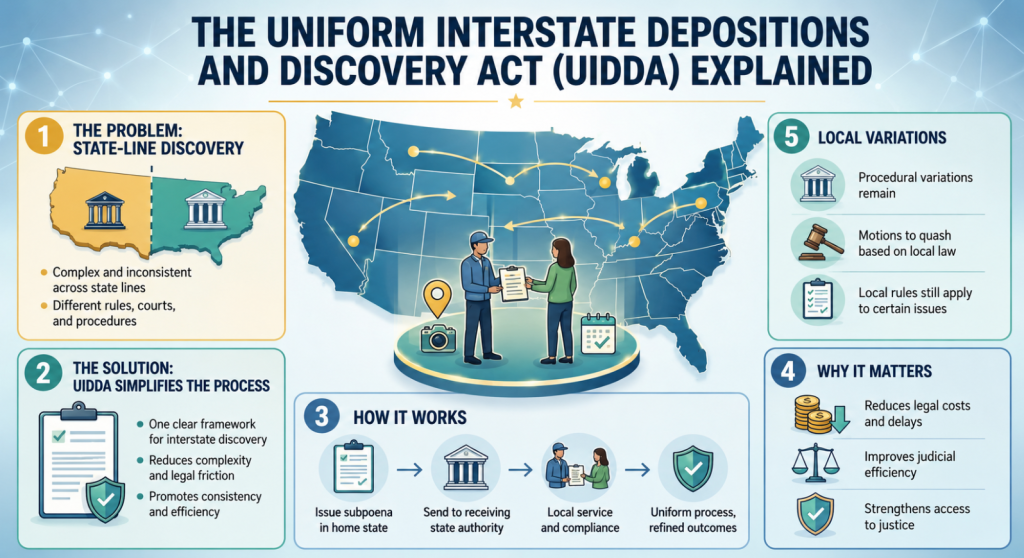
The basic UIDDA workflow has four steps: (1) verify the discovery state has adopted UIDDA, (2) prepare the subpoena form in the trial state per that state’s rules, specifying the testimony or discoverable materials sought, (3) present the trial-state subpoena to the court clerk in the discovery state’s appropriate county or district, and (4) have the clerk-issued local subpoena served on the witness — typically by a registered process server — using the discovery state’s service rules. The trial-state attorney often does not need to retain local counsel for issuance.
In California specifically, this workflow runs through Cal. Civ. Proc. Code §§ 2029.100 through 2029.900. The mechanics are documented operationally in the How to Domesticate an Out-of-State Subpoena in California guide, which walks through the SUBP-030 application and the county-by-county filing mechanics.
UIDDA simplifies interstate discovery by eliminating three procedural barriers that defined the old process: the need to file a separate miscellaneous action in the discovery state, the requirement of formal commissions or letters rogatory from the trial court, and judicial review of routine subpoena issuance in the discovery state. In their place, UIDDA establishes a clerk-issued local subpoena that the trial-state attorney can request directly.
Two states’ rules apply simultaneously. The trial state’s discovery rules govern what may be sought — the scope of the subpoena, the deposition topics, the document requests, the deadlines for compliance. The discovery state’s rules govern how the subpoena is served, what objections and motion practice are available to the witness, and what privileges and protections apply to the witness in the witness’s home jurisdiction.
This dual-rule structure is the most commonly misunderstood aspect of UIDDA. The model act language deliberately leaves scope to the issuing court and procedure to the receiving court. Attorneys who treat a UIDDA subpoena as a fully trial-state-governed instrument run into trouble when the discovery-state witness moves to quash under local privacy rules or local objection deadlines that the trial-state attorney didn’t expect.
Pro tip — from the field. Before drafting the trial-state subpoena, identify the specific county or district in the discovery state where the witness resides and pull that county’s UIDDA filing instructions from the clerk’s website. Counties within the same state often have different cover-sheet requirements, filing fees, and submission formats — and a subpoena rejected by the clerk for a missing local form delays service by a week or more. The verification call to the clerk’s office takes ten minutes and prevents the most common procedural rejection.
As of late 2025 — and subject to change as legislatures consider pending bills — the non-UIDDA jurisdictions are Massachusetts, Missouri, and New Hampshire. In those states, out-of-state attorneys seeking discovery generally must file a miscellaneous action or petition in the discovery state’s court, often with locally licensed counsel, and obtain a judge’s review before a subpoena issues. The process resembles the pre-UIDDA framework the other 48 states have already replaced.
Practical consequence: when a California case needs discovery from a Massachusetts custodian, the California-pending attorney follows a process closer to the pre-UIDDA framework. Local Massachusetts counsel typically files a petition for issuance of a subpoena duces tecum in the Massachusetts trial court where the custodian is located. The same is true for Missouri and New Hampshire matters. Build extra time and budget for these three foreign jurisdictions until they adopt UIDDA themselves — and re-verify adoption status before relying on the framework, because legislative sessions can change the map quickly.
No. While UIDDA is a uniform model, individual states have implemented it with local variations — different filing fees, different cover-sheet requirements, different deadlines for objection, and in some states, different judicial-review provisions for sensitive discovery categories. The model act’s core mechanic (clerk-issued local subpoena from trial-state subpoena) is consistent across adopting states, but the operational details vary.
California’s implementation under Cal. Civ. Proc. Code §§ 2029.100 et seq. is among the more straightforward — the SUBP-030 form package, county-clerk filing, ministerial issuance. Texas’s recent adoption under Rule 201.3 follows the model act closely but adds at least one important Texas-specific carve-out: as currently written, Rule 201.3 does not authorize clerks to issue subpoenas for premises inspections; premises-inspection requests still require a court order. That carve-out is current as of late 2025 and could be modified in future amendments. Florida’s implementation (Fla. Stat. § 92.251) requires the foreign subpoena to be accompanied by a request for issuance. Attorneys handling multi-state matters benefit from a state-by-state working knowledge of these variations, or from a service partner that maintains it.
UIDDA has substantially lowered the cost and time required for out-of-state subpoenas. Costs that used to include a miscellaneous-action filing fee, local counsel retainer, and judicial-review delay are now reduced in most cases to the clerk’s filing fee and the cost of service. For a California case with five out-of-state custodians, that often translates to thousands of dollars saved and weeks shaved off the discovery schedule.
The change has operational implications beyond pure cost. Cases that involve out-of-state witnesses or custodians are now economically viable to bring discovery against, where pre-UIDDA they sometimes were not. Plaintiffs’ counsel evaluating whether to depose a far-flung corporate custodian, or defense counsel evaluating whether to subpoena an out-of-state regulatory body, run a different cost-benefit analysis post-UIDDA than they did fifteen years ago. The framework has measurably expanded the reach of state-court discovery.
Verify three things before relying on UIDDA: (1) the discovery state has adopted UIDDA and adoption is current as of the matter’s discovery deadline, (2) the specific county or district in the discovery state where the witness resides has documented filing procedures the trial-state attorney can follow, and (3) the trial-state subpoena’s scope satisfies both the trial state’s discovery rules and the discovery state’s privacy, privilege, and objection rules. Skipping any of these verifications is the most common source of UIDDA subpoena delays and motion practice.
This article is the foundational explainer for the broader UIDDA content cluster. For the California-specific operational mechanics — SUBP-030 application, county clerk filing, and service of the domesticated subpoena — see How to Domesticate an Out-of-State Subpoena in California. For the broader strategic context on why interstate-coordination capability matters more in 2026 than it did five years ago, see The State of Process Serving in 2026, the hub piece for this editorial cluster.
For attorneys working on the underlying California subpoena rules that get layered with UIDDA when a California subpoena needs to reach an out-of-state witness, California Civil Subpoenas: A Practical Guide to CCP §§ 1985 through 1997 covers the Chapter 2 framework. Operational support for both inbound and outbound UIDDA traffic is available through the Countrywide Process Subpoena Domestication service.
Countrywide Process handles UIDDA traffic in both directions — domesticating out-of-state subpoenas for service on California witnesses, and supporting California-pending attorneys who need discovery from witnesses in any of the 48 UIDDA states. We maintain working knowledge of state-by-state variations, county-by-county filing requirements, and the procedural quirks that turn a routine UIDDA pass into a two-week delay if not anticipated. Explore the Subpoena Domestication service for full UIDDA support, or the Process Serving Services page for California subpoena service generally.
This article is provided for informational purposes only and does not constitute legal advice. UIDDA implementation varies by state and adoption status changes over time; readers should verify both adoption status and current statutory text before relying on any specific procedural framework. The statutory references in this article — including the Uniform Law Commission’s 2007 promulgation, Cal. Civ. Proc. Code §§ 2029.100-2029.900, Texas Rule of Civil Procedure 201.3, and the adoption status of UIDDA across U.S. jurisdictions as of late 2025 — should be verified against current authoritative sources and the applicable local rules of the receiving court. Legal teams should consult qualified counsel to ensure compliance with the rules applicable to their specific matters. Countrywide Process assumes no liability for reliance on this information without consultation of applicable legal authorities.
UIDDA stands for the Uniform Interstate Depositions and Discovery Act. It is a Uniform Law Commission model statute completed in 2007 that creates a streamlined process for obtaining out-of-state subpoenas in state-court civil litigation. As of late 2025, 48 U.S. states plus the District of Columbia and the U.S. Virgin Islands have adopted UIDDA in some form, by statute or court rule
As of late 2025, Massachusetts, Missouri, and New Hampshire have not adopted UIDDA. Adoption status is subject to change as state legislatures act on pending bills. In the three non-UIDDA jurisdictions, out-of-state attorneys seeking discovery from local witnesses must follow each state’s pre-existing procedure, which generally requires filing a miscellaneous action or petition in the discovery state’s court with locally licensed counsel before a subpoena can issue.
No. UIDDA is a state-law mechanism for state-court civil litigation. Federal court cases are governed by Federal Rule of Civil Procedure 45, which has its own framework for out-of-state subpoenas in federal litigation. UIDDA was specifically designed to bring state-court interstate discovery practice closer to the streamlined federal process that already existed under Rule 45.
The UIDDA process typically takes days to weeks, depending on the clerk’s processing time in the discovery state’s county or district. This is a substantial reduction from the pre-UIDDA framework, which typically required weeks to months because it involved filing a separate miscellaneous action and obtaining judicial review in the discovery state. Service of the issued subpoena on the witness then proceeds under the discovery state’s service rules, generally through a registered process server.
California implements UIDDA through Cal. Civ. Proc. Code §§ 2029.100 through 2029.900. The framework covers application procedure, the SUBP-030 subpoena form package for issuance, county clerk filing, and the service and compliance rules that govern California witnesses subpoenaed in out-of-state matters. The California implementation is among the more straightforward state adoptions of the UIDDA model act.