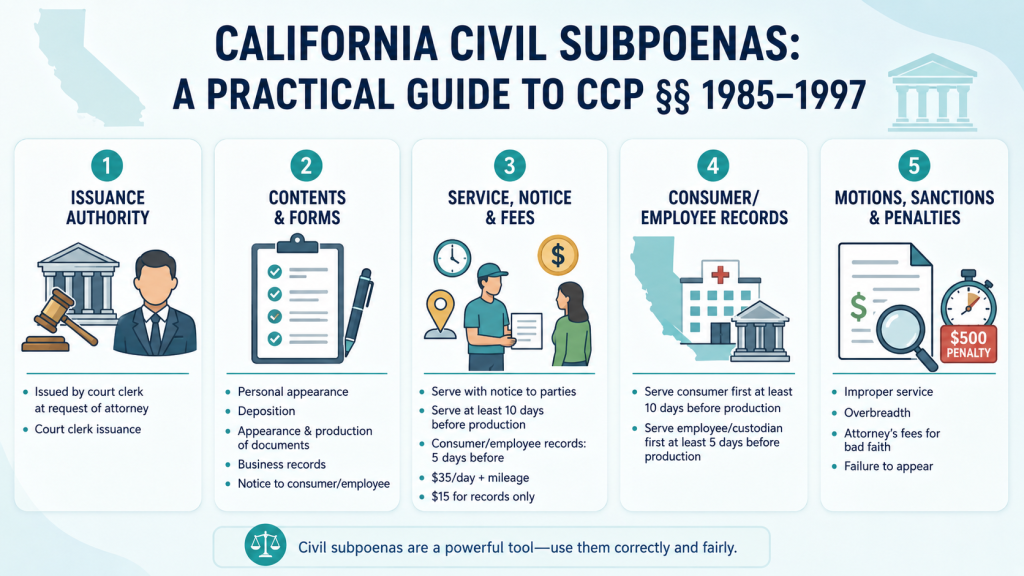
California Code of Civil Procedure §§ 1985 through 1997 — Chapter 2 of Title 3, “Means of Production” — is the operating system for every civil subpoena issued in a California superior court. The chapter governs who can issue a subpoena (CCP § 1986), what it must contain (CCP § 1985), how it must be served (CCP § 1987), the witness fees that must be tendered ($35.00 per day plus mileage for personal-appearance subpoenas, and $15.00 for records-only subpoenas under Gov. Code § 68097.2), how a recipient objects or moves to quash (CCP §§ 1985.3(g), 1987.1), and what happens when a witness ignores the subpoena (CCP § 1992 — a $500 forfeiture in addition to damages).
For California civil litigators and the paralegals who prepare these documents, the practical question is which of the chapter’s overlapping sections applies to the specific subpoena type — and what the documentary record needs to look like to survive an objection or motion to quash.
California civil subpoena procedure is governed by Code of Civil Procedure §§ 1985 through 1997. The chapter covers issuance authority, contents, service, witness fees, consumer-records and employee-records notices, motions to quash, sanctions, and failure-to-appear penalties. Six Judicial Council forms — SUBP-001, SUBP-002, SUBP-010, SUBP-015, SUBP-020, and SUBP-025 — implement these sections for trial-and-hearing, deposition, and consumer-notice purposes.
Countrywide Process
May 22, 2026
The table below maps each California civil subpoena type to its primary governing CCP section and the Judicial Council form attorneys actually file. This is the working reference paralegals need at the moment of drafting.
| Subpoena type | Form | Primary CCP citation | Practical use |
| Civil subpoena for personal appearance at trial or hearing | SUBP-001 | §§ 1985, 1986, 1987 | Compels a non-party witness to appear and testify at trial or hearing. No document production. |
| Civil subpoena (duces tecum) for personal appearance and production of documents, ESI, and things at trial or hearing | SUBP-002 | § 1985 et seq. | Combined trial/hearing appearance and document production. Requires a supporting declaration showing good cause for production. |
| Deposition subpoena for production of business records | SUBP-010 | §§ 2020.410–2020.440 | Records-only subpoena to a custodian of business records (no personal appearance). |
| Deposition subpoena for personal appearance | SUBP-015 | § 2020.310 | Compels a non-party witness to appear and testify at a deposition only. |
| Deposition subpoena for personal appearance and production of documents and things | SUBP-020 | § 2020.510 | Combined deposition appearance and document production. |
| Notice to Consumer or Employee and Objection | SUBP-025 | §§ 1985.3, 1985.6 | Pre-service notice when subpoenaing a consumer’s or employee’s personal records. |
Under CCP § 1986, a California civil subpoena may be issued by the clerk of the court, by a judge, or by an attorney of record in the action. The clerk issues a blank, signed, and sealed subpoena that the requesting party fills out; an attorney of record may both issue and sign the subpoena directly without first obtaining a clerk’s signature.
In day-to-day litigation, an attorney of record will almost always self-issue under § 1986 — the clerk’s-signature path is reserved primarily for self-represented litigants and for matters where local rules require it. Either way, the subpoena is court process, not a private demand; the recipient’s obligation to respond is enforceable through the court’s contempt and sanctions powers.
Under CCP § 1985(a), a valid civil subpoena must contain the name of the court, the names of the parties, an order to appear and testify or to produce specified documents at a stated time and place, and — for subpoenas duces tecum — a declaration showing good cause for production. The Judicial Council mandatory forms capture every required element in a single instrument.
CCP § 1985(b) is the declaration requirement most often overlooked in practice. A subpoena duces tecum for documents must be supported by a declaration showing good cause for the production, specifying the exact materials to be produced and demonstrating their materiality to the issues. A bare-bones “any and all documents” demand is the single most common drafting error in records subpoenas and the most reliable basis for a successful objection.
Under CCP § 1987(a), a civil subpoena is served by personal delivery of a copy to the witness, with the witness fees and one day’s mileage tendered or offered at the time of service if demanded. Service must allow the witness a reasonable time for preparation and travel. Any person of legal age who is not a party to the action may make service.
The reasonable-time requirement is not abstract. For records subpoenas governed by § 1985.6(d) and § 2020.220(a), service must be effected sufficiently in advance to give the custodian a reasonable opportunity to locate and produce the designated records. A hospital custodian cannot produce ten years of patient records on a week’s notice, and a court asked to compel that production will rarely require the impossible.
Yes. Under CCP § 1987(b), a written notice served on a party (or a person whose attendance is being procured by a party) at least 10 days before the required attendance has the same legal effect as service of a subpoena. The notice path is reserved for parties and the people they control; non-party witnesses still require a properly served subpoena under § 1987(a).
Pro tip — from the field. Hospital and medical-provider custodians of records routinely reject records subpoenas on technical grounds the subpoenaing attorney can fix in advance. The three most common rejection triggers are: (1) the $15.00 witness fee was not enclosed with service; (2) the records request was not specific enough to identify the records without a chart review; and (3) the SUBP-025 Notice to Consumer was not served on the patient first, or was served on the wrong address. Confirming all three before service eliminates roughly half the back-and-forth that delays records production.
CCP § 1985.3 requires a Notice to Consumer (Form SUBP-025) whenever a subpoena duces tecum seeks the personal records of a consumer — including medical, banking, credit-card, insurance, telephone, and most utility records — from a third-party custodian. The notice must be served on the consumer at least 10 days before the production date and at least 5 days before service of the subpoena on the custodian.
CCP § 1985.6 imposes a parallel notice requirement for employee personnel records subpoenaed from an employer. The two sections operate in tandem: a subpoena seeking medical records of a third-party witness from a hospital triggers § 1985.3; a subpoena seeking a non-party’s personnel file from their current employer triggers § 1985.6; and a subpoena seeking the personnel file of a party-employee from their employer triggers both consumer-records protections and the party-employee’s separate rights under the discovery statutes.
Under CCP § 1985.3(g), a consumer may serve a written objection on the subpoenaing party and the records custodian at any time before the date set for production. Once the objection is served, the custodian may not produce the records except by order of the court or by agreement of the parties, witnesses, and consumers affected. The subpoenaing party may move to enforce under § 1987.1 within 20 days.
Under CCP § 1987.1, the court may quash, modify, or condition a subpoena on grounds including improper service, overbreadth, oppressiveness, lack of materiality, encroachment on privacy or privileged information, undue burden, or noncompliance with the notice requirements of §§ 1985.3 or 1985.6. The motion may be brought by the witness, the consumer, the employee, any party, or any other affected person.
CCP § 1987.2 adds sanctions teeth: the court may award the reasonable expenses incurred in making or opposing a motion to quash, including attorney’s fees, if it finds the motion (or the opposition) was made in bad faith, without substantial justification, or that the subpoena was oppressive. Fee-shifting is discretionary but exercised more often than many practitioners assume — particularly in the consumer-records context, where overbroad subpoenas to medical providers are a frequent target.
Under CCP § 1992, a witness who fails to appear in response to a properly served subpoena, without lawful excuse, forfeits $500 to the aggrieved party in addition to any damages the party may sustain by the failure to appear. The forfeiture is recoverable in a civil action. The witness may also be held in contempt under CCP § 1209 and compelled to attend by court order.
This article is the foundational reference for the broader California subpoena content cluster. For form-by-form mechanics, the Civil Subpoena: Complete Guide for California Attorneys [2026] covers the subpoena lifecycle from issuance through enforcement in greater operational detail. For the strategic context — why documentation standards matter more in 2026 than they did five years ago — see The State of Process Serving in 2026, the hub piece for this editorial cluster.
For multi-state matters where an out-of-state subpoena needs to be domesticated for service on a California witness, How to Domesticate an Out-of-State Subpoena in California walks through the UIDDA process under Cal. Civ. Proc. Code §§ 2029.100 et seq., the SUBP-030 application, and the county-by-county filing mechanics. Operational support for subpoena traffic in either direction is available through the Countrywide Process Subpoena Domestication service.
This article is provided for informational purposes only and does not constitute legal advice. California civil subpoena procedure is governed by statute, court rules, and local rules that may vary by county and matter type. The statutory citations referenced — including CCP §§ 1985, 1985.3, 1985.6, 1986, 1987, 1987.1, 1987.2, 1988, 1992, 2020.310, 2020.410, and 2020.510, and California Government Code §§ 68093 and 68097.2 — should be verified against the current text on the California Legislative Information website and the applicable local rules of the receiving court. Legal teams should consult qualified counsel to ensure compliance with the rules applicable to their specific matters. Countrywide Process assumes no liability for reliance on this information without consultation of applicable legal authorities.
CCP § 1985 is the general civil-subpoena statute governing trial-and-hearing subpoenas (issued on Form SUBP-001). CCP § 2020.510, part of the Civil Discovery Act, governs deposition subpoenas for personal appearance and production of documents (issued on Form SUBP-020). The two statutes overlap in fundamentals — issuance, service, witness fees — but the deposition-subpoena provisions add discovery-specific requirements that trial subpoenas do not.
California civil subpoena witness fees are set by California Government Code § 68093: $35.00 per day for attendance at trial or deposition, plus mileage at the rate established by the Judicial Council. For records-only subpoenas, the witness fee is $15.00 per California Government Code § 68097.2, payable to the records custodian at the time of service. Public-entity witnesses are governed by separate fee provisions in Government Code §§ 68096.1-68097.10.
Under CCP § 1987(a), any person of legal age who is not a party to the action may serve a California civil subpoena. Service must be by personal delivery to the witness, with witness fees and one day’s mileage tendered if demanded. In practice, civil subpoenas are most commonly served by registered California process servers because the proof of service must demonstrate compliance with the statutory service requirements.
A witness who, without lawful excuse, fails to appear in response to a properly served California civil subpoena is subject to a $500 forfeiture under CCP § 1992, plus any damages caused by the failure to appear, recoverable by the aggrieved party in a civil action. The witness may also be held in contempt under CCP § 1209 and compelled to attend by court order. Sanctions are recoverable separately under CCP § 1987.2 in motion practice.