On January 1, 2026, California Code of Civil Procedure § 413.30 took effect in its amended form (Stats. 2025, ch. 403), authorizing courts — upon motion and a showing of reasonable diligence — to direct that summons be served by electronic means when traditional methods authorized under chapter 4 of the Code of Civil Procedure have failed. The change has been described by the Daily Journal as a long-overdue modernization of California civil procedure, and by the State Bar as the most significant structural change to service of summons rules in more than three decades.
For California litigation attorneys handling matters where a defendant cannot be located through ordinary means — whether because the defendant is actively evading service, has relocated without leaving a forwarding address, or operates primarily through online channels — the new framework offers a faster, more practical path forward than the historical alternatives of publication or repeated substituted-service attempts. But the new rules also impose specific documentation requirements that attorneys must understand before filing a motion under the amended statute. This guide walks through the structure of the law, the reasonable diligence showing that judges expect, the approved electronic methods, and the procedural steps from motion to filed proof of service.
Countrywide Process
May 13, 2026
Prior to 2026, California’s framework for service of summons was set forth in Code of Civil Procedure §§ 415.10 through 415.95. Personal service under § 415.10 remained the default; substituted service at the defendant’s home or business under § 415.20 was available after diligent attempts at personal service; service by mail with acknowledgment of receipt was authorized under § 415.30; service by posting was available in unlawful detainer matters under § 415.45; and service by publication was available as a last resort under § 415.50 after the court was satisfied that the defendant could not, with reasonable diligence, be served in any other manner specified in the statute.
The amendment to CCP § 413.30 adds a new subsection (a)(1) authorizing the court, upon motion, to direct that summons be served by electronic means when the plaintiff has exercised reasonable diligence using the methods authorized in the chapter and has been unable to effect service. The court may approve any electronic method that is, in the court’s judgment, reasonably calculated to give actual notice to the party to be served — the same constitutional touchstone that the U.S. Supreme Court articulated in Mullane v. Central Hanover Bank & Trust Co., 339 U.S. 306 (1950), and that California courts have applied to alternative service questions ever since.
In practical terms, the amendment codifies what California federal courts and a handful of state trial courts had already been doing under ad hoc orders for several years: approving service by email, social media, or secure digital platforms in cases where the plaintiff had clearly demonstrated that traditional service was infeasible. What was previously a matter of judicial discretion exercised case-by-case is now a defined procedural pathway with clear standards.
Important: The amended statute does not apply in actions against a governmental entity or an agent or employee of the governmental entity acting within the scope of that employment. For those defendants, the traditional service methods set forth in CCP §§ 415.10 through 415.95 remain the exclusive framework. Attorneys preparing matters against public agencies, public officers, or public employees in their official capacity should not rely on the CCP § 413.30 pathway.
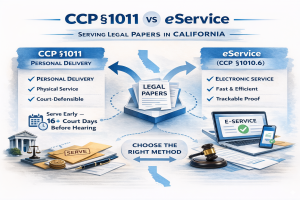
The table below summarizes how the new electronic service framework relates to the traditional methods already authorized under CCP §§ 415.10 through 415.50.
| Element | Traditional service of process | Electronic service under CCP § 413.30 (2026) |
| Court approval required? | No — process server proceeds directly | Yes — motion and order required |
| Reasonable diligence showing | Required only for substituted service (CCP § 415.20) or publication (CCP § 415.50) | Required as threshold prerequisite for any electronic service order |
| Methods available | Personal (§ 415.10), substituted (§ 415.20), mail w/ acknowledgment (§ 415.30), posting (§ 415.45), publication (§ 415.50) | Email to verified address, secure digital service platform, messaging through verified online account, or other method the court approves |
| Proof of service | Process server affidavit, posting affidavit, publication declaration | Delivery confirmation, access logs, screenshots, and platform receipts as specified in the court order |
| When deemed complete | Varies by method (immediately on personal service; 10 days after mailing for substituted, etc.) | As specified in the court order; typically on documented delivery or access |
Reasonable diligence is the threshold question in every electronic service motion under the amended statute. A court will not authorize electronic service merely because the plaintiff prefers a digital method or finds traditional service inconvenient. The plaintiff must demonstrate that traditional methods have been attempted in good faith and have failed.
California courts have applied a multi-factor analysis to reasonable diligence questions for decades, and the same framework governs motions under the amended CCP § 413.30. Although the precise showing required will vary by case, a complete declaration of due diligence supporting an electronic service motion will typically include the following elements:
Practical note: a thin declaration of diligence is the single most common reason electronic service motions are denied. Judges read these declarations carefully because the consequence of an approved-but-defective electronic service is a void judgment vulnerable to attack on appeal. A well-documented declaration with attached exhibits is materially more likely to be granted than a conclusory one.
The amended statute does not prescribe an exclusive list of electronic methods. Rather, it authorizes the court to approve any method that is reasonably calculated to give actual notice. In practice, California courts have shown a clear hierarchy of comfort with different digital channels.
Email to a verified address
Email is the most commonly approved electronic service method, both because it is the most directly analogous to traditional mail service and because courts have decades of comfort with email as a legitimate means of legal notice in the post-summons context under CCP § 1010.6. To support an email service motion, the plaintiff should demonstrate that the email address is currently active, that the defendant has used it within a reasonable recent time period, and that the email account is associated with the defendant rather than with a third party.
Secure digital service platforms
Several commercial platforms now exist specifically for legal electronic service, providing delivery tracking, access logs, identity verification, and tamper-resistant audit trails. Courts increasingly view platform-based service as preferable to ordinary email because the platform itself generates the proof-of-service documentation. For high-value matters or where post-service authentication is likely to be contested, platform-based service offers a measurable evidentiary advantage.
Messaging through verified online accounts
Service through direct messaging on a social media platform, professional networking site, or online community account is the most disfavored of the three categories but is occasionally approved where the defendant has been demonstrably active on the platform and has not been reachable by any other means. The leading case in this line is St. Francis Assisi v. Kuwait Finance House, 2016 WL 5725002 (N.D. Cal. 2016), where the court approved service by Twitter on a defendant the plaintiff could not locate through traditional means. California state courts have been more conservative than their federal counterparts on social-media service, but the amended statute provides clearer authority for state-court approvals going forward.
Once the reasonable diligence record is in place and the proposed electronic method has been identified, the procedural path to electronic service follows a defined sequence:
In the early months since the amended statute took effect, several patterns of defective electronic service have emerged from motion practice and from contested service hearings. Attorneys should be aware of these pitfalls when planning an electronic service strategy:
Although the amended statute is framed around elusive defendants, the implications reach further. Three secondary effects are already visible:
First, the formal availability of electronic service shortens litigation timelines for matters that previously stalled at the service stage. A typical publication-based service under CCP § 415.50 requires at least four weeks of newspaper publication and frequently several additional weeks for the supporting motion and order. A properly supported electronic service motion can be granted within days of filing and executed within the same week.
Second, the documentation rigor required for an electronic service motion is changing how attorneys instruct process servers. Where attorneys previously asked for a single attempt-and-affidavit, more sophisticated practitioners are now requesting full diligence packages from the outset — multiple attempts with GPS-stamped photographs, contemporaneous skip-trace reports, and documented verification of any digital contact information — anticipating that the diligence record may need to support a future electronic service motion if traditional methods fail.
Third, the new framework is accelerating a broader shift in how California civil procedure treats digital communication channels. The amended § 413.30 follows the 2024 expansion of mandatory eService under § 1010.6 for represented parties, the Los Angeles Superior Court’s November 2024 launch of electronic notice transmission for civil cases, and ongoing rule-making by the Judicial Council on digital court records. The combined effect is a procedural environment in which the default assumption is digital, and physical service is becoming the exception used where digital is infeasible rather than the default.
The amended statute places new emphasis on the quality of the underlying service record. A process serving partner who can deliver a complete, contemporaneously documented diligence package — multiple attempts at the correct addresses, GPS-stamped photographic evidence, complementary skip tracing on bad-address cases, and verified digital contact information for the proposed electronic recipient — materially improves the likelihood that an electronic service motion will be granted on the first filing.
Countrywide Process, LLC has provided legal support services to California attorneys since 2004 and now processes more than 64,000 orders annually across both legacy and digital channels. The firm’s standard service protocols include GPS-stamped attempt logs, complimentary skip tracing on every bad-address service job, and full digital diligence packages for matters likely to require a CCP § 413.30 motion. For attorneys preparing electronic service motions under the new framework, the diligence record produced by a sophisticated process serving partner is often the difference between a granted and a denied motion.
Countrywide Process, LLC is a California-based legal support services firm established in 2004, providing Service of Process, court eFiling, county recorder eRecording, court filing, courtesy copy delivery, and skip tracing to attorneys and legal departments across California and nationwide. The firm is a member of the California Association of Legal Support Professionals (CALSPro) and the National Association of Professional Process Servers (NAPPS). For more information or to discuss a specific service requirement, contact the firm at (888) 962-9696 or info@countrywideprocess.com.
This article is provided for general informational purposes only and does not constitute legal advice, legal opinion, or a substitute for consultation with a qualified attorney. Statutory citations, case references, and procedural descriptions reflect Countrywide Process, LLC’s understanding of California civil procedure as of the date of publication, but California Code of Civil Procedure provisions and judicial interpretations evolve continuously. Attorneys handling matters under California Code of Civil Procedure § 413.30 or any related provision should consult primary sources, current case law, and applicable Rules of Court before relying on any procedural strategy described in this article. No attorney-client relationship is created by reading this article or contacting Countrywide Process, LLC. Countrywide Process, LLC provides legal support services and does not practice law or render legal advice.