A court subpoena serves as one of the most formidable discovery tools in the American legal system, functioning as a legally binding mandate that compels individuals or organizations to provide testimony (subpoena ad testificandum) or produce physical evidence and records (subpoena duces tecum). For attorneys managing complex litigation or businesses navigating third-party discovery requests, understanding the mechanics of a properly served subpoena is critical, as these orders carry the full weight of judicial authority. Failing to provide a timely or compliant response can lead to severe legal exposure, including being held in contempt of court, facing significant monetary sanctions, or even risking arrest and incarceration. However, because not every request is enforceable, legal professionals often evaluate a subpoena’s validity for defects or overbreadth, potentially filing a motion to quash or asserting legal privilege—such as attorney-client or work-product protections—to shield sensitive information from disclosure.
This comprehensive guide explains what a court subpoena is, the different types you may encounter, the federal and California rules that govern them, how they must be served, and how to respond or object. We will also cover what happens when someone ignores a subpoena and why working with a professional process service company makes compliance easier on every side of the case.
Countrywide Process
May 12, 2026
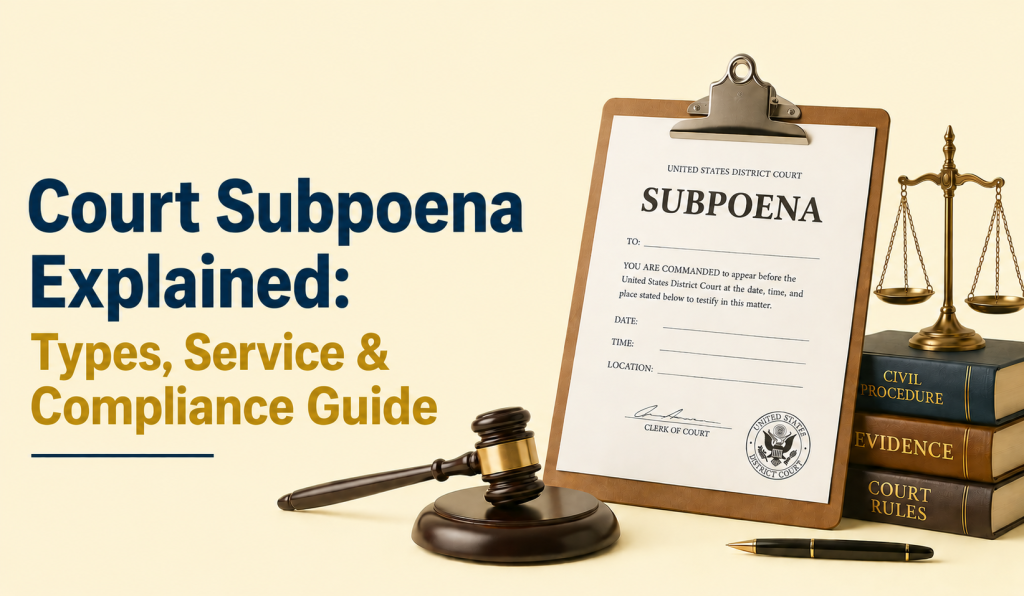
A court subpoena (from the Latin sub poena, meaning “under penalty”) is a formal legal order issued in connection with a pending case. It directs the recipient to do one or more of the following: appear at a deposition, hearing, or trial; produce documents, electronically stored information (ESI), or physical evidence; or permit inspection of premises. Because the subpoena is issued under the authority of a court, ignoring it can result in court-imposed penalties.
The purpose of a court subpoena is to ensure that parties and non-parties alike contribute the evidence necessary for a just outcome. Litigants do not have unlimited investigative power, so the subpoena bridges the gap between what a party knows and what a third party can prove. In civil, criminal, administrative, and grand jury proceedings, subpoenas are the engine that drives discovery and trial preparation.
Many people assume every subpoena is signed by a judge. In modern American practice, that is rarely the case. Most civil subpoenas are issued by attorneys as officers of the court, while certain criminal and judicial subpoenas are signed by a judge or court clerk.
Under the Federal Rules of Civil Procedure (FRCP) and most state codes, attorneys admitted to practice may issue and sign subpoenas in the name of the issuing court. The attorney does not need a judge’s signature; the subpoena is enforceable because the attorney is an officer of the court. This system speeds up discovery but places ethical responsibility on counsel to avoid undue burden or harassment.
Judge-signed subpoenas are typically used when a self-represented (pro per) litigant needs a subpoena, when criminal trial witnesses are summoned, when a grand jury issues process, or when special circumstances (such as subpoenas to incarcerated individuals) require judicial oversight. The clerk of court issues the subpoena under the judge’s authority, and recipients see a court seal rather than only an attorney signature.
Both forms carry the same compulsory force. The distinction matters mostly for procedural reasons, including who can challenge the subpoena and how it is served on certain custodians of records.
There are three primary types of court subpoenas you will see in civil and criminal practice. Each compels a different action and is governed by overlapping but distinct rules.
A subpoena duces tecum (“bring with you”) commands the recipient to produce documents, records, or tangible items. Today this often includes ESI (Electronically Stored Information) such as emails, text messages, surveillance video, cloud storage, and database exports. Common targets are banks, hospitals, employers, telecom carriers, and social media providers. The subpoena must describe the items sought with reasonable particularity and allow a reasonable time for compliance.
A subpoena ad testificandum compels personal appearance to testify at a deposition, hearing, arbitration, or trial. The recipient must appear at the stated time and place and answer questions under oath. Unlike a duces tecum subpoena, no records are required — only the witness’s knowledge.
A deposition subpoena is a hybrid used in civil discovery. It can require a non-party to appear for a deposition, produce documents at the deposition, or both. In California, deposition subpoenas are governed primarily by Code of Civil Procedure (CCP) sections 2020.010 through 2020.510 and come in three flavors: records only, personal appearance only, and personal appearance with records.
In federal court, subpoenas are governed by Federal Rule of Civil Procedure 45. Rule 45 was substantially amended in 2013 to clarify issuance, service, geographic reach, and protections for non-parties. The rule applies to civil litigation in U.S. district courts and is mirrored in many state systems.
Every Rule 45 subpoena must:
A Rule 45 subpoena must be served by any non-party who is at least 18 years old. Service requires personal delivery of a copy to the named person. If the subpoena commands attendance, the server must also tender witness fees and reasonable mileage at the rates set by 28 U.S.C. § 1821 (currently $40 per day plus mileage). Failure to tender fees can render service defective.
Rule 45(c) sets strict geographic limits, often called the “100-mile rule.” A subpoena may command attendance for a deposition, hearing, or trial only:
For document production, the place of compliance must be within 100 miles of the recipient’s residence, workplace, or regular business location. These limits prevent forum-shopping subpoenas that drag witnesses across the country.
Rule 45(d) requires the issuing party and attorney to take reasonable steps to avoid imposing undue burden or expense. The court must enforce this duty and may impose sanctions — including lost earnings and attorney’s fees — on parties or attorneys who violate it. Recipients have 14 days to serve written objections to document subpoenas, and they may move to quash or modify on grounds such as privilege, undue burden, or geographic violation.
California has its own detailed subpoena framework in the Code of Civil Procedure. While many concepts mirror federal rules, several California-specific provisions trip up out-of-state counsel.
California uses Judicial Council forms (e.g., SUBP-001, SUBP-002, SUBP-010, SUBP-015. SUBP-020) for civil subpoenas. The forms are mandatory or optional depending on the type, and they must be completed precisely. CCP §§ 1985–1997 govern trial and hearing subpoenas, while CCP §§ 2020.010–2020.510 govern deposition subpoenas in civil discovery.
When a subpoena seeks personal records of a “consumer” or employment records of an “employee” from a third party (such as a bank, doctor, or employer), CCP §§ 1985.3 and 1985.6 require advance notice to the consumer or employee. The serving party must give the records custodian and the consumer/employee a Notice to Consumer or Notice to Employee at least 10 days before the production date — plus an additional 5 days for service by mail — to allow time to object by utilizing the SUBP-025..
California witness fees are set by Government Code § 68093 at $35 per day plus $0.20 per mile (one way) for civil cases. Peace officer witness fees are higher and governed by separate statutes. Like federal practice, fees must generally be tendered with service to a non-party witness commanded to appear.
California has adopted the Uniform Interstate Depositions and Discovery Act (UIDDA) at CCP §§ 2029.100–2029.900. Under UIDDA, an out-of-state subpoena can be domesticated through the California court system without filing a miscellaneous action. For a step-by-step walkthrough, see our Nationwide UIDDA Subpoena Domestication Guide. We also handle foreign subpoena domestication and service for attorneys nationwide.
Whether issued in federal or state court, a valid court subpoena should include the following elements. Missing or defective elements are common grounds to quash.
Service is the legal act of delivering the subpoena so the recipient is officially on notice. Improper service is one of the most common reasons subpoenas are unenforceable.
Both Rule 45(b) and California CCP § 1987 generally require personal service — hand-delivery to the named individual or to the authorized agent of an entity. Mail, email, or leaving the subpoena with a relative is usually insufficient unless the recipient agrees in writing or a court order permits it. Some California subpoenas (consumer/employee records) allow service by mail with acknowledgment, but only in limited circumstances.
Federal subpoenas may be served by any non-party 18 or older. California requires service by a non-party 18 or older; for compensation, the server must be a registered process server, sheriff, marshal, or licensed investigator. Using a registered, insured process server protects the validity of service and provides a credible proof of service if service is later challenged.
After service, the server must complete a Proof of Service or Affidavit of Service stating who was served, when, where, and how. This document is filed with the court (or kept for trial) and is the evidentiary record that the subpoena was properly delivered. Without it, enforcement is essentially impossible.
Geographic limits define how far a witness can be compelled to travel. They protect non-parties from oppressive subpoenas and shape strategy for multi-state litigation.
Under FRCP Rule 45(c), a non-party witness cannot be commanded to travel more than 100 miles from where they live, work, or regularly transact business in person. For party witnesses, the limit extends statewide. The same 100-mile limit applies to document production locations.
In-state subpoenas (issued and served within the same state) follow that state’s rules — in California, however the UIDDA Interstate subpoenas are more complex: a subpoena issued in State A generally has no power in State B. To reach an out-of-state witness, the requesting attorney must domesticate the subpoena in the witness’s state, typically through UIDDA.
When scheduling a deposition in California, “location, location, location” isn’t just a real estate mantra—it’s a statutory requirement. Under CCP § 2025.250, the proximity of the witness to the deposition site is strictly governed to prevent undue burden.
The California Code of Civil Procedure sets specific mileage “bubbles” based on who is being deposed:
Beyond geography, California law imposes strict limits on the “how long” and “how often” of discovery:
Note: While trial subpoenas can technically reach anyone within the state, the court retains the power to “quash” or cancel any subpoena that creates an unreasonable hardship for the witness.
Responding correctly to a court subpoena is a multi-step process. Acting quickly preserves your rights and avoids accidental waivers.
Identify who issued it, what is demanded, the deadline, and the location of compliance. Note whether it is a testimony subpoena, a records subpoena, or both.
Federal document subpoenas allow 14 days from service to serve written objections (Rule 45(d)(2)(B)). California consumer/employee record subpoenas usually require objection at least 5 days before production. Missing these dates can waive privileges.
As soon as a subpoena is received, issue a litigation hold to prevent deletion of any responsive documents or ESI. Spoliation can lead to severe sanctions even if the underlying subpoena is later quashed.
Review for attorney-client privilege, work product, trade secrets, HIPAA-protected health information, financial privacy, and personnel record protections. Privileged material must be logged on a privilege log.
Before filing motions, contact the issuing attorney to negotiate scope, format, deadlines, and cost-shifting for ESI (Electronically Stored Information). Most disputes are resolved here. Document the discussion in writing.
If terms are reasonable, produce the records and/or appear. If not, serve formal written objections within the deadline and, if necessary, file a motion to quash or for a protective order.
A motion to quash asks the court to invalidate or modify a subpoena. It is the strongest formal objection available. Common valid grounds include:
Motions are filed in the court that issued the subpoena (or, for production subpoenas, in the district where compliance is required). The moving party should attach a meet-and-confer declaration showing good-faith attempts to resolve the dispute. Courts often modify rather than fully quash subpoenas, narrowing scope or shifting costs.
Ignoring a court subpoena is never a safe option. Penalties escalate quickly and can include both civil and criminal consequences.
FRCP Rule 45(g) provides that a court “may hold in contempt a person who, having been served, fails without adequate excuse to obey the subpoena.” California Code of Civil Procedure § 1209 similarly classifies disobedience as contempt. Contempt can be civil (coercive, lifted upon compliance) or criminal (punitive). Penalties range from daily fines to jail time.
Courts routinely order non-compliant recipients to pay the requesting party’s attorney’s fees and costs incurred in enforcing the subpoena. In federal court, sanctions can include lost earnings under Rule 45(d)(1). In California, evidentiary, issue, and terminating sanctions are available against parties who use subpoena defiance to obstruct discovery.
In criminal cases and certain civil contexts, a judge may issue a bench warrant for a witness who fails to appear. Arrest is a real risk for witnesses who repeatedly disregard subpoenas. Even in civil cases, body attachment orders can result in detention until the witness testifies.
If a party fails to object timely, privileges (including attorney-client) may be deemed waived. Courts may also instruct juries to draw adverse inferences from a party’s refusal to produce evidence properly subpoenaed.
Whether you are issuing a subpoena or have just received one, working with a professional process serving company eliminates most procedural risks. Countrywide Process has decades of experience serving subpoenas across California and nationwide.
A court subpoena is a serious legal instrument with strict rules at every step — issuance, service, compliance, objection, and enforcement. Whether you are operating under FRCP Rule 45 in federal court or California’s Code of Civil Procedure, the smallest mistake can invalidate service or expose your client (or you) to sanctions. Understanding the types of subpoenas, the 100-mile rule, witness fees, and response deadlines is the foundation of effective discovery practice and proper compliance.
When the stakes are high, partner with a team that handles court subpoenas every day. Countrywide Process delivers fast, court-compliant subpoena service across California and the country, paired with full-service court filing and UIDDA domestication. Contact Countrywide Process today for a free quote or to place your subpoena order — and let our experts make sure your court subpoena is served correctly the first time.
No. Ignoring a court subpoena exposes you to contempt, fines, and possibly arrest. If you believe the subpoena is improper, serve timely written objections and, if necessary, file a motion to quash. Always consult an attorney before disregarding any court process.
Federal Rule 45 does not set a fixed minimum, but it requires “reasonable time for compliance.” Courts generally consider 14 days the floor for document production. California consumer/employee record subpoenas require at least 15 days (10 days plus 5 for mail) before production.
Yes. Federal witnesses receive $40 per day plus mileage under 28 U.S.C. § 1821. California civil witnesses receive $35 per day plus $0.20 per mile under Government Code § 68093. Fees are usually tendered when the subpoena is served. Records custodians may also recover reasonable copying and search costs.
Generally no. Under FRCP Rule 45(c), non-party witnesses cannot be required to travel more than 100 miles from their residence, workplace, or regular place of business. Party witnesses can be compelled statewide. Out-of-state subpoenas must be domesticated through UIDDA in the witness’s state.
A summons notifies a defendant that they have been sued and must respond to a complaint. A court subpoena, by contrast, compels a witness or custodian — often a non-party — to provide testimony, documents, or both. Different rules govern each.
Any non-party adult 18 or older may serve a subpoena, but if the server is paid, California requires a registered process server, sheriff, marshal, or licensed investigator. Using a registered process server protects the validity of service and ensures a credible proof of service.
Yes. Attorney-client communications, attorney work product, doctor-patient information, and other privileged categories are protected. You must serve a timely objection and produce a privilege log identifying each withheld document by date, author, recipient, and basis for privilege.
A witness who testifies falsely under oath commits perjury, a felony in both federal court (18 U.S.C. § 1621) and California (Penal Code § 118). Penalties include imprisonment, fines, and loss of professional licenses. The subpoena does not change a witness’s honesty obligation — it enforces it.
Use the Uniform Interstate Depositions and Discovery Act (UIDDA), adopted in most states including California. Issue the subpoena in the trial state, then domesticate it in the discovery state where the witness or records are located. Countrywide Process handles UIDDA domestication and service nationwide.
We offer Standard, Priority, Urgent, and On-Demand service levels. On-Demand service can put a server in front of your recipient within hours in major California metros, with same-day proof of service. Contact us for a quote based on the recipient’s location and your discovery deadline.