The legal support services industry is in the middle of the most significant structural change it has experienced in at least two decades. Five distinct forces — some statutory, some operational, some technological — are converging on the same outcome: a process serving and legal support model that is faster, more documented, more digitally integrated, and more accountable than the model most California attorneys grew up with.
This article is the reference piece for the rest of the Countrywide Process editorial series on the future of the industry. Each of the five forces below is anchored to a verifiable source — a statute, a court order, a technical capability, or a documented industry pattern — rather than to a generic trend. Each is treated as a discrete development that attorneys and law firm operations managers can plan around. The articles that follow in this series treat each force in greater depth.
Countrywide Process
May 13, 2026
The table below summarizes the five forces with their primary source citations. The sections that follow walk through each force in detail.
| # | Force | What changed and where to verify |
| 1 | California’s electronic service framework | CCP § 413.30 amended by Stats. 2025, Ch. 403 (SB 85, Umberg), effective January 1, 2026. Authorizes electronic service of summons upon court order after reasonable diligence. |
| 2 | Court-driven eService expansion | Los Angeles Superior Court eService launch (November 22, 2024) and phased expansion through civil case types (May 22, 2025), implementing CCP § 1010.6 obligations. |
| 3 | API-driven county recording | Simplifile and similar platforms now connect to county recorder offices nationwide, enabling same-day electronic recording of judgments, lis pendens, and real-property documents. |
| 4 | AI-assisted intake, routing, and skip tracing | Machine-learning identity resolution, automated address validation, and predictive routing are entering legal-support workflows as standard capabilities rather than premium add-ons. |
| 5 | Workflow convergence | Law firms increasingly expect a single legal-support partner for eFiling, eService, eRecording, physical service, and proof retrieval — rather than coordinating multiple vendors. |
California Senate Bill 85 (Umberg), chaptered as Statutes of 2025, Chapter 403, amended Code of Civil Procedure § 413.30 effective January 1, 2026. The amendment authorizes a court — upon motion and a showing of reasonable diligence — to direct that summons be served “by electronic mail or other electronic technology” when traditional methods have failed.
This is the single most consequential statutory change in California civil procedure for service of process in the last thirty years. It is the codification of a practice that California federal courts and a handful of state trial courts had been authorizing case-by-case for several years — service by email, secure digital platform, or messaging through verified online accounts — into a defined procedural pathway with explicit standards and a documented diligence requirement.
The amended statute imposes three specific requirements. First, the plaintiff must demonstrate reasonable diligence using the traditional service methods authorized in CCP §§ 415.10 through 415.50. Second, the diligence record must detail all attempts to serve the defendant by each of the methods prescribed by statute, including facts demonstrating why each method was unsuccessful at every address or location where the defendant is likely to be found. Third, the court order must specify the electronic method to be used and the form of proof of service required.
The statute does not apply in actions against governmental entities or their agents or employees acting within the scope of their employment. For those defendants, the traditional service methods remain the exclusive framework. This carve-out is the most commonly missed nuance in early commentary on the new rule, and attorneys preparing matters against public agencies should not rely on the new pathway.
For a detailed walkthrough of CCP § 413.30 motions, see the companion article “Electronic Service of Process in California 2026: The Complete Guide.” For the diligence-documentation checklist, see “The Reasonable Diligence Checklist.” Both are available on the Countrywide Process site.
The second force is independent of the first but reinforces it. California courts are expanding their electronic service infrastructure rapidly, implementing the obligations of CCP § 1010.6 in ways that materially change how represented parties receive court-issued documents.
The Los Angeles Superior Court is the most visible example. On November 22, 2024, the court announced the phased launch of eService for civil case types, beginning with appeals, family law, probate, and mental health matters. On May 22, 2025, the court announced an expansion of eService to additional civil case types, including unlawful detainer and small claims. The practical effect is that attorneys with cases before LASC increasingly receive notices, orders, and other court-issued documents through the court’s electronic transmission system rather than through traditional mail.
The LASC expansion is not an outlier. Superior courts across California are implementing comparable eService systems on staggered timelines, and the San Diego Superior Court has issued similar public notices outlining its own implementation schedule. The combined effect is that within the next 24 to 36 months, the default channel for court-issued notices in California will be electronic transmission rather than mail.
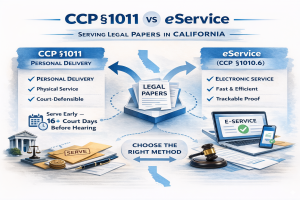
This force is often conflated with Force 1, but the two operate on different legal foundations and apply at different procedural stages. CCP § 413.30 governs initial service of summons by the plaintiff on the defendant. CCP § 1010.6 governs post-summons service of documents by the court or by parties on represented opposing counsel. Conflating the two is one of the most common errors in California civil practice, and the next article in this series addresses the distinction directly.
The third force has been operating quietly for years but reached an inflection point in 2024–2025. County recorder offices across the United States now accept electronic submission of recordable documents through API-driven platforms, with Simplifile (a Fidelity National Financial company) being the most widely deployed. The platform connects to recorder offices across nearly all U.S. states, enabling same-business-day electronic recording of judgments, lis pendens, real-property deeds, and similar documents.
The practical consequence for litigation support is significant. A judgment that previously required physical delivery to a county recorder office — sometimes by overnight courier when the recorder was in a different county — can now be electronically submitted, indexed, and confirmed within hours. For lis pendens filings in real estate litigation, the speed differential can be the difference between protecting and losing a client’s position in a property dispute.
This force interacts with Forces 1 and 2 in non-obvious ways. Attorneys preparing electronic service motions under CCP § 413.30 sometimes also need to record related documents — attachments, liens, or notices — with county recorders. The ability to coordinate electronic service, eFiling, and eRecording through a single workflow rather than three separate ones is a meaningful operational advance that the convergence force (Force 5) describes more broadly.
The fourth force is the maturation of artificial intelligence within legal-support workflows. The honest assessment is that AI is not replacing process servers, court researchers, or skip tracers in any near-term horizon — the legal accountability and identity-verification requirements of the work demand human judgment. But AI is rapidly improving the quality of the inputs to that work.
Three specific applications have moved from experimental to operational over the last 18 months. First, machine-learning identity resolution combines public-records data, social-network signals, address-history databases, and consumer reporting agency outputs to surface defendant locations that traditional skip tracing missed. Second, automated address validation against postal service databases, parcel-data services, and aerial-imagery services catches bad addresses at intake rather than after a failed field attempt. Third, predictive routing assigns the most appropriate field server to each job based on geography, service history, and case-type expertise, reducing the operational waste of poorly-matched assignments.
None of these capabilities are unique to any single vendor. What separates legal support firms applying AI well from those merely talking about it is whether the AI is improving the quality of an already-rigorous workflow or substituting for one. Used responsibly, AI is a quality-improvement layer that compounds with experienced human judgment. Used carelessly, AI becomes an additional source of error and a liability when service is challenged.
The fifth force is the synthesis of the first four. Law firms increasingly expect a single legal-support partner for what was historically a fragmented vendor relationship. The unified workflow now spans eFiling of the complaint, electronic service or court-approved physical service of the summons, eRecording of related documents with county recorders, post-summons eService of pleadings and discovery, skip tracing on bad-address jobs, and digital proof retrieval — all coordinated through a single client interface and a single billing relationship.
This convergence reflects a deeper shift in how law firms think about legal support. The old model treated each function as an independent transaction managed by a different specialty vendor: one company for process serving, another for court filing, another for record retrieval, another for skip tracing. The integration cost of coordinating four to six separate vendors per case was tolerable when case volumes were low and timelines were long. As both have changed, the integration cost has become prohibitive.
The legal support firms that are positioned for the next decade are those that can deliver this unified workflow without sacrificing the rigor of any individual function. The firms that are not positioned for it tend to fall into two categories: traditional process serving operations that have not integrated digital capabilities, and digital-first platforms that have not invested in the operational depth required for compliance-sensitive work. The defensible position is the middle ground: deep operational expertise in each function, integrated through a modern technology platform, delivered through a single client relationship.
Five forces are reshaping the industry, but several things have not changed and are unlikely to. Due process still depends on actual notice to the defendant, regardless of the channel. Reasonable diligence still requires good-faith effort across multiple methods, not a shortcut to whichever method is most convenient. Proof of service is still evaluated on its substantive content, not its format. The process server is still the person responsible for the legal sufficiency of the field work, and the attorney is still the person responsible for the legal sufficiency of the motion that relies on it.
Not every modernization sticks. The legal support industry has seen its share of technology fads that promised to reshape it and quietly receded — fully-automated process serving platforms that did not survive contact with the actual diligence requirements of California courts, AI scheduling tools that produced more routing errors than they solved, and integration platforms that combined many vendors loosely without adding meaningful value at the case level. Judgment about which technologies materially improve service and which are automation theater matters more in 2026 than it did five years ago.
The five forces above are the ones that have produced verifiable, durable change. The articles that follow in this series treat each in greater depth, and together they describe the operational shape of a legal-support practice that is meaningfully better than the one most attorneys experienced even two or three years ago.
Countrywide Process, LLC has supported California attorneys since 2004. The firm’s current operational footprint covers all five of the forces described above: complete documentation for CCP § 413.30 motions through GPS-stamped attempt logs and verified digital contact information; coordination with court-side eService systems including LASC; eRecording through the Simplifile API to county recorders across the country; AI-assisted intake validation and routing layered onto experienced human service judgment; and a unified client interface spanning eFiling, eService, eRecording, physical service, skip tracing, and proof retrieval.
For attorneys planning their 2026 legal-support strategy in light of the changes described above, Countrywide Process can provide an operational walkthrough of how the firm’s capabilities map to specific case types and service requirements. Contact the firm at (888) 962-9696 or info@countrywideprocess.com to schedule a brief introductory conversation.
Countrywide Process, LLC is a California-based legal support services firm established in 2004, providing Service of Process, court eFiling, county recorder eRecording, court filing, courtesy copy delivery, and skip tracing to attorneys and legal departments across California and nationwide. The firm is a member of the California Association of Legal Support Professionals (CALSPro) and the National Association of Professional Process Servers (NAPPS). For more information, contact the firm at (888) 962-9696 or info@countrywideprocess.com.
This article is provided for general informational purposes only and does not constitute legal advice, legal opinion, or a substitute for consultation with a qualified attorney. Statutory citations, case references, and procedural descriptions reflect Countrywide Process, LLC’s understanding of California civil procedure and operational industry developments as of the date of publication, but California Code of Civil Procedure provisions, court rules, and technology vendor capabilities evolve continuously. Attorneys handling matters affected by any of the developments described in this article should consult primary sources, current case law, and applicable Rules of Court before relying on any procedural strategy. No attorney-client relationship is created by reading this article or contacting Countrywide Process, LLC. Countrywide Process, LLC provides legal support services and does not practice law or render legal advice.