In California motion practice, service is not a mere administrative task—it is schedule control. Once jurisdiction is established via the Summons and Complaint, the strategic focus shifts to the service of moving and subsequent papers.
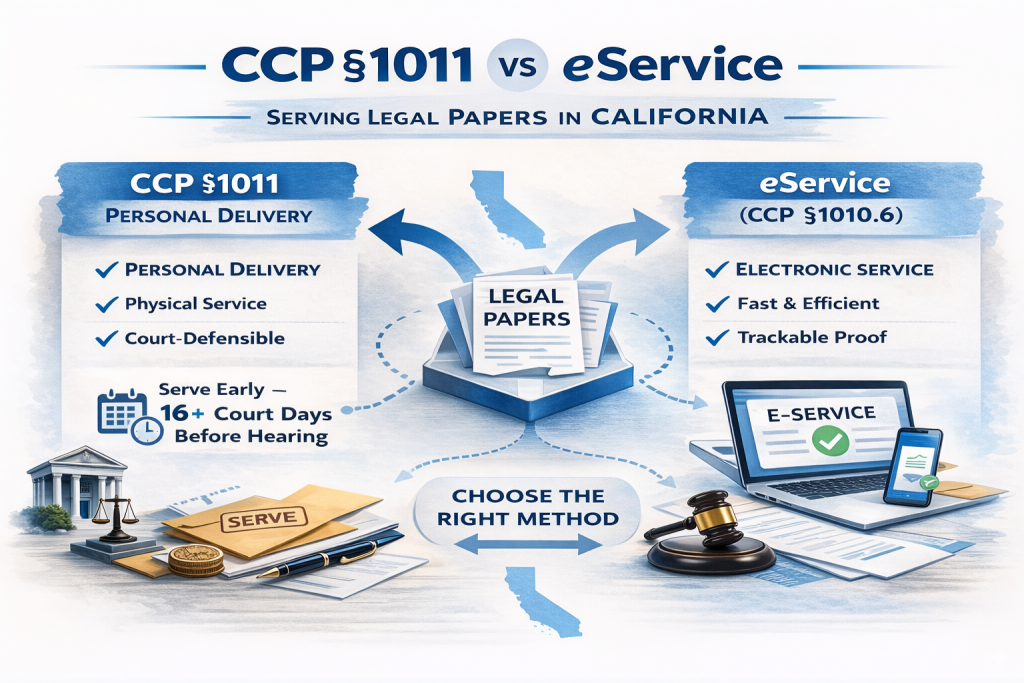
Attorneys and/or Self Litigants must navigate the choice between two primary standards:
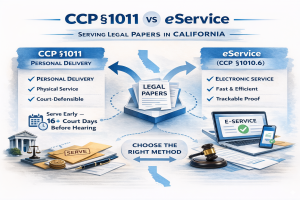
Whether you are opting for the physical “drop” of §1011 or the digital “click” of §1010.6, the goal is the same: protecting your deadline and ensuring a bulletproof court record.
Countrywide Process
February 23, 2026
A typical moving papers packet includes:
Subsequent papers are the papers that come after the moving papers—usually to respond to the motion or complete the briefing.
Common examples:
California motion timelines (especially oppositions and replies) often create a “short runway.” That’s why attorneys sometimes choose a faster, more defensible service method rather than relying on slower delivery pathways.
Core timing checkpoint attorneys watch
CCP §1005 provides baseline timing rules for moving papers and for opposition/reply papers in many motion contexts.
And Rule 3.1300 (Rules of Court) includes key requirements about motion filing and related proof-of-service timing in many noticed motion settings.
Plain-English takeaway:
As the hearing date gets closer, service becomes less about “what’s allowed” and more about “what reliably lands on time with a clean record.”
Option A: CCP §1011 Personal Delivery (Physical Service of Papers)
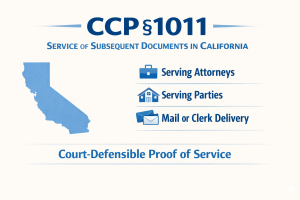
CCP §1011 governs personal service of “notices and other moving or subsequent papers” in an ongoing case.
It matters because it gives different rules depending on who you’re serving:
Serving an attorney (office-focused)
CCP §1011 allows service at the attorney’s office by leaving papers with:
If nobody is available, CCP §1011 includes a “conspicuous place” option during a specific time window (9 a.m.–5 p.m.) in the office.
Serving a party directly (residence-focused)
If serving a party (often self-represented), CCP §1011 allows leaving papers at the party’s residence with a person 18+, and attempts at the residence must be made between 8 a.m. and 8 p.m.
Why attorneys choose CCP §1011 for tight timelines:
Because it can produce a clear, time-stamped delivery event that is easy to describe in a proof of service.
Option B: eService Under CCP §1010.6 (Electronic Service)
CCP §1010.6 governs electronic service of documents.
Plain-English benefit:
eService is fast, consistent, and fits modern case workflows—especially when parties are already set up for electronic service.
Plain-English caution:
You still need a defensible record (who was served, how, when), and attorneys should account for any timing rules and court requirements that apply to their specific motion and case posture.
Choose the method that best ensures your papers are delivered on time and your proof is hard to attack.
The proof of service document represents the official record of how and when service was completed.
Countrywide Process, LLC
Countrywide Process, LLC supports attorneys and legal teams with compliant, security-minded service workflows across California. We are a bonded, registered entity, and our operations are designed to be secure and tech-forward—focused on accuracy, documentation quality, and process control that reduces risk on time-sensitive filings and motion practice.
Need help with CCP §1011 service of subsequent documents?
Less Chaos More Control, Let Countrywide Take the Role
Important (Not Legal Advice)
Countrywide Process, LLC is not a law firm. We are not attorneys, and nothing in this article is to be considered legal advice. This content is provided for general informational purposes only. Attorneys and self represented parties should confirm requirements against CCP §1011, CCP §1005, CCP §1010.6, and applicable California Rules of Court, and apply independent legal judgment based on case posture and any court orders.
Moving papers are the documents the moving party files and serves to ask the court for an order. They start a motion and typically include a notice of motion, the motion, points and authorities, declarations, exhibits, and often a proposed order.
Subsequent papers are the documents filed after moving papers—most commonly opposition papers and reply papers—plus any permitted supporting declarations or exhibits used to complete the briefing.
CCP §1011 governs personal service of notices and other moving or subsequent papers in an ongoing case and provides different methods depending on whether the recipient is an attorney or a party.
An attorney may be served at the attorney’s office by leaving papers in a clearly labeled envelope or package identifying the attorney being served with a receptionist or a person having charge of the office, as allowed by CCP §1011.
CCP §1011 includes an option to leave papers in a conspicuous place in the attorney’s office during a specified time window when no one is available to accept service, subject to the statute’s conditions.
When applicable, CCP §1011 allows leaving papers at the party’s residence with a person at least 18 years old, and attempts at residence service must occur within the statute’s permitted hours.
eService is electronic service of documents governed by CCP §1010.6 and applicable Rules of Court, which define how electronic service is performed and how service timing is treated.
It depends. CCP §1011 personal delivery can provide a clear delivery event and strong documentation. eService under CCP §1010.6 can be faster and more scalable when electronic service is authorized and properly documented.
Proof of service is the record showing what was served, who was served, when, where, and how. A clear proof helps avoid service disputes that can delay hearings or create briefing issues.
Yes. Motion timing rules and court procedures set deadlines for service and proof filing, so attorneys often choose the service method that best ensures timely delivery and a defensible record.