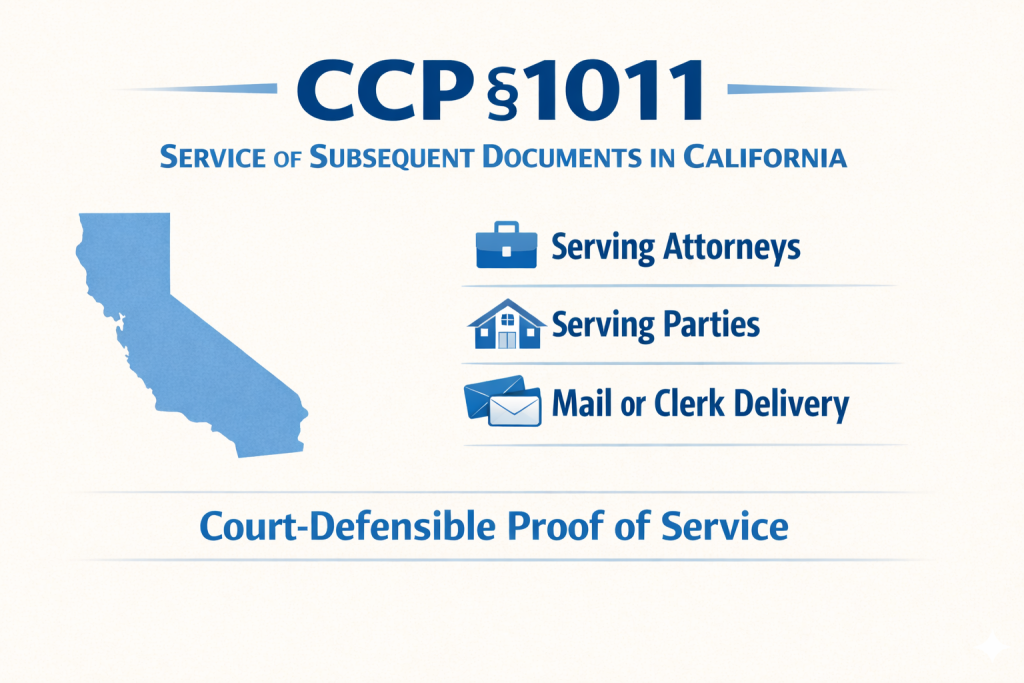
California CCP §1011 governs personal service of notices and other moving or subsequent papers in an active case, with different rules for serving attorneys at their office and serving parties at their residence. This guide explains the method choices, time windows, and motion timing checkpoints attorneys use to keep filings on calendar and defensible.
Countrywide Process
February 23, 2026
When a California case is already underway, you’re no longer “starting the lawsuit”—you’re keeping it moving. CCP §1011 is the statute attorneys rely on for personal service of “notices and other moving or subsequent papers” (think: motion papers, oppositions, replies, discovery papers, notices, and similar litigation documents served during the life of the case). CCP §1011 governs service of documents in ongoing legal proceedings and is part of California civil procedure.
This guide explains CCP §1011 in plain language and maps it to common attorney workflows—especially motion practice where timing and proof of service can make or break a hearing schedule. Proper service of process is essential to ensure valid service and maintain the integrity of the legal process.
CCP §1011 is a “how to serve papers” rule for an existing case. It tells you where and how papers can be personally served depending on who you are serving:
CCP §1011 also applies when serving other parties involved in the case, ensuring all parties receive proper notice.
In real practice, CCP §1011 is commonly used for serving legal documents such as:
CCP §1011 is not the main authority for serving the initial summons and complaint to start a civil lawsuit.
Moving papers are the full set of court papers the “moving party”—often the plaintiff—files and serves to ask the court for an order. A typical motion packet includes (all of which are types of court papers filed in the case):
California Rules of Court Rule 3.1112 covers required motion content and related requirements.
CCP §1011 explains how to serve; motion rules explain when service has to happen.
Case law may impact the interpretation of timing requirements for service and filing.
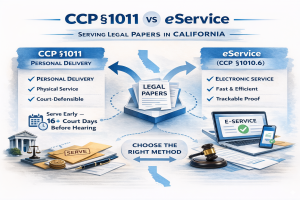
CCP §1005 generally requires moving and supporting papers to be served and filed at least 16 court days before the hearing (unless a different law or court order changes it). Note that in federal court cases, the federal rules may set different deadlines for serving and filing moving papers.
California Rules of Court Rule 3.1300 generally requires the proof of service of the moving papers to be filed no later than five court days before the hearing, unless the court orders otherwise. Filing proof of service is necessary to prove service was properly completed and to demonstrate to the court that the documents were delivered as required.
Simple takeaway:Even if service was done correctly under CCP §1011, you can still have a problem if motion timing or proof filing timing is missed.
For attorneys, CCP §1011 is built around office delivery, and the manner of service must comply with the office delivery requirements specified in CCP §1011(a).
You can serve counsel by leaving the papers at the attorney’s office in an envelope/package clearly labeled to identify the attorney being served, with:
Simple best practice:If you want the proof to be hard to attack, the proof should clearly state:
If nobody is available in the office to accept the papers, CCP §1011 allows leaving the papers between 9:00 a.m. and 5:00 p.m. in a conspicuous place in the office.
Plain-English meaning:This is not “leave it anywhere.” It’s limited to:
It is important to document the receipt or acknowledgment of the papers left, such as by obtaining a delivery log or other proof, to confirm proper service.
CCP §1011(a) contains additional options (like residence delivery, mailing, or clerk delivery) only when certain conditions are met (for example, when the office is not open to admit service, or when addresses are unknown, etc.). A registered process server who is not a party to the case may be used to serve documents, ensuring compliance with legal requirements.
Simple rule:Fallback methods are not “whatever is easiest.” Your proof should reflect why the fallback method was used. \
“Think of CCP 1011 as a flowchart, not a menu. You only move to ‘Step B’ because ‘Step A’ was physically impossible. At Countrywide Process, LLC, we ensure our field notes reflect these specific triggers so your service survives any scrutiny in court.”
CCP §1011(b) starts by recognizing that some “particular cases” have their own service method. If not, the default rule below applies.
If no special rule applies, you may serve the party by leaving the papers at the party’s residence with a person of suitable age and discretion, at least 18 years old.
Any attempted service at a residence under CCP §1011(b) must occur between 8 a.m. and 8 p.m.
If no adult (18+) can be found at the residence at the time of service, CCP §1011(b) allows service by mail, which may include the use of certified mail to provide proof of delivery.
If the party’s residence is not known, CCP §1011(b) permits delivering the papers to the court clerk of the court for that party.
If service is done electronically, CCP §1011(c) says it must be done under CCP §1010.6 and the applicable Rules of Court. Electronic service may be completed through the court’s electronic filing system, which is governed by electronic filing rules.
Plain-English meaning:eService has its own rule set. If you’re serving electronically, you follow the eService statute/rules—not the physical delivery mechanics.
Countrywide Process, LLC
Countrywide Process, LLC supports attorneys and legal teams with compliant, security-minded service workflows across California. We are a bonded, registered entity, and our operations are designed to be secure and tech-forward—focused on accuracy, documentation quality, and process control that reduces risk on time-sensitive filings and motion practice. We ensure all steps are complete for proper service of documents, meeting all jurisdictional requirements.
Need help with CCP §1011 service of subsequent documents?
Call 888.962.9696 or contact us here: countrywideprocess.com/contact-us
Less Chaos More Control, Let Countrywide Take the Role
Important (Not Legal Advice)
Countrywide Process, LLC is not a law firm. We are not attorneys, and nothing in this article is legal advice. This content is provided for general informational purposes only. Attorneys should confirm requirements against CCP §1011, CCP §1005, and applicable California Rules of Court, and apply independent legal judgment based on case posture and any court orders.
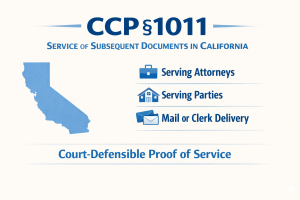
CCP §1011 is used to personally serve notices and other moving or subsequent papers in an ongoing case. It governs the service of process for subsequent legal documents, providing different methods for serving attorneys versus serving parties, plus fallback methods like mail or clerk delivery when specific conditions apply.
Moving papers are the full set of legal documents filed and served by the moving party to request a court order. A typical packet includes a notice of motion, the motion, a memorandum of points and authorities, declarations, exhibits, and often a proposed order. These legal documents may affect personal jurisdiction if not properly served.
You may serve an attorney, who is the subject of service, at the attorney’s office by leaving the papers in a clearly labeled envelope or package identifying the attorney being served with a receptionist or a person having charge of the office.
If no one is available in the attorney’s office to accept the papers, CCP §1011(a) allows leaving them between 9:00 a.m. and 5:00 p.m. in a conspicuous place in the office. Proof of service is required to establish valid service of process.
If no case-specific service rule applies, you may serve the party, who may be the defendant or other parties in the case, by leaving the papers at the party’s residence with a person at least 18 years old.
Any attempt at service at a party’s residence under CCP §1011(b) must be made between 8:00 a.m. and 8:00 p.m. The service must be attempted at the party’s usual place of abode.
If no person at least 18 years old can be found at the residence at the time of service, CCP §1011(b) allows such service by mail, which may require proof of mailing.
If the party’s residence is not known, CCP §1011(b) allows delivering the papers to the clerk of the court, for that party. In such cases, the court clerk may accept service of process.
CCP §1005 generally requires moving and supporting papers to be served and filed at least 16 court days before the hearing, unless another law or a court order changes the timing. Proper forms must be used for service and filing.
CCP §1011(c) says that if service is made electronically, it must be made under CCP §1010.6 and the applicable California Rules of Court for eService. Electronic service is a valid method to serve process and provide actual notice to the parties.