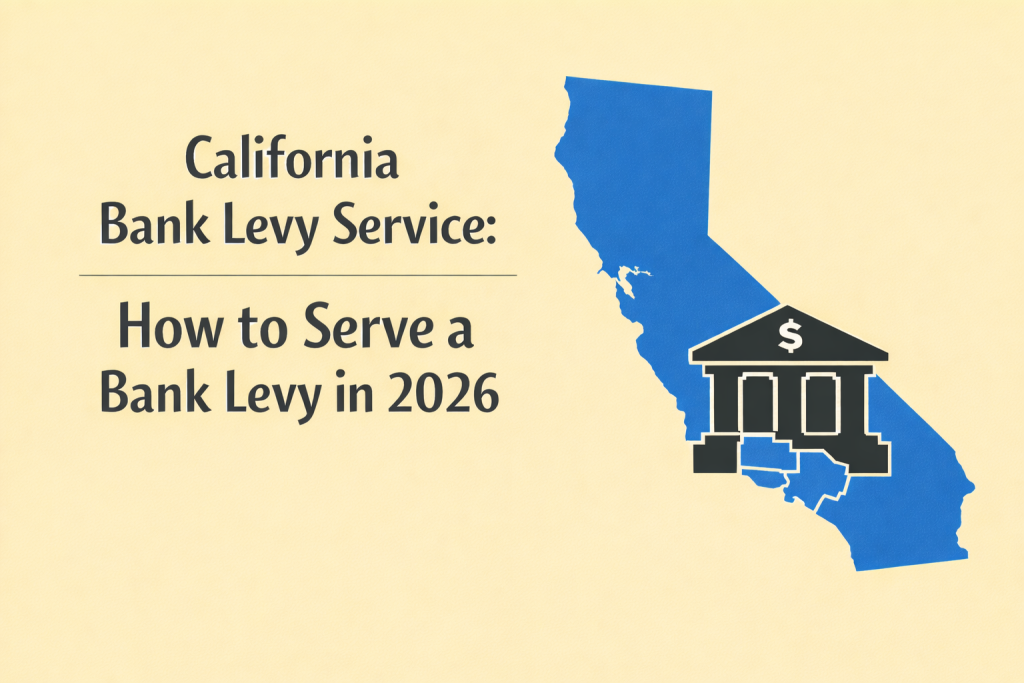
In 2026, bank levies in California require filing with the Sheriff and service by a Registered Process Server (RPS) in counties like Alameda, San Mateo, and Santa Clara. This guide outlines exactly which forms to submit, where RPS service is mandatory, and how Countrywide Process ensures compliance.
This 2026 Bank Levy Hub Guide provides California attorneys with current procedures for executing levies through sheriffs or Registered Process Servers (RPS), including up-to-date forms, compliance requirements, and county-specific enforcement limitations.
Countrywide Process
February 11, 2026
To enforce a judgment through a California Bank Levy, attorneys must:
Under the new California law (California Assembly Bill 2364, effective January 1, 2013), creditors and judgment creditors can now levy on one or more accounts at several large banks by obtaining only one writ of execution, making the process more efficient and cost-effective. The new law allows creditors to access all of a debtor’s funds at any branch of a designated bank with a single writ of execution. Bank levies are one-time actions that only take money from the debtor’s bank account when the bank is served, so timing the service (choosing the exact date) is crucial to maximize the chance of attaching funds. The sheriff’s department and sheriff’s office play a key role in the process, and creditors often rely on their expertise to collect money owed.
Countrywide Process bridges this gap—handling statewide Sheriff file openings + RPS service with full compliance.
Counties Where RPS is Required
| County | Sheriff Serves Bank Levies? | RPS Required? |
|---|---|---|
| Alameda | ❌ No | Yes (View Guide) |
| San Mateo | ❌ No | Yes (View Guide) |
| Santa Clara | ❌ No | Yes (View Guide) |
| San Diego | Limited | Strongly Advised (View Guide) |
| Los Angeles | Yes (Backlogged) | RPS Preferred (View Guide) |
To open the bank levy file, you must submit all required documents, including original documents where necessary, to the Sheriff’s Civil Unit:
Writs of Execution expire after 180 days, so ensure all documents are current before submission.
Before you can serve a bank levy in California, you must first identify where the judgment debtor maintains their bank accounts. Locating these accounts is a critical step in the legal process, as a successful levy depends on serving the correct financial institutions with the proper documents.
Here are proven strategies to help you pinpoint the debtor’s bank account:
As you gather information, keep detailed records of all potential bank accounts, account holders, and any related businesses or fictitious business names. In some cases, you may need to provide additional documentation—such as a spousal affidavit or a copy of the fictitious business name statement—to support your claim when serving the notice of levy.
By following these steps and collaborating with a registered process server or legal professionals, you can streamline the process of locating the debtor’s bank accounts. This preparation ensures you are ready to obtain a writ of execution, serve the correct financial institution, and ultimately collect the money owed through a California bank levy.
Once the Sheriff opens the levy file, the Registered Process Server must serve all levy-related documents, including notices and writs of execution, to the bank and, if applicable, to other account holders on the account.
After the levy is served, the bank must freeze non-exempt accounts and has 10 days to turn over the funds to the Sheriff, who is responsible for releasing funds to the creditor.
If the debtor believes their funds are exempt, they have 15 to 20 days to file a Claim of Exemption. If a Claim of Exemption is filed, the Sheriff will send a copy to the judgment creditor.
Hiring a professional process server can streamline the bank levy process.
Under California law, banks with 10 or more branches must designate a central address (also called the bank’s central address or designated central addresses) for service of levy-related documents. This new law allows creditors to serve levy-related documents to the central address, making it possible to access all of a debtor’s accounts (debtor’s accounts) at any branch or other branches of the bank, rather than just the specific branch where the debtor’s bank account is held. This is especially relevant for the largest banks, many of which have their central address in Los Angeles County. Previously, funds could only be collected from the specific branch where the levy documents were served, leaving other accounts untouched. Now, this change makes it easier to locate and levy on all of a debtor’s accounts at large banks.
For banks with 10+ California branches, you must serve at their designated location listed with the Department of Financial Protection & Innovation (DFPI):
🔗 Read CCP § 684.115
RPS vs Sheriff Service Comparison
| Feature | Sheriff Only | RPS via Countrywide |
|---|---|---|
| Available in all counties | ❌ No | ✅ Yes |
| Turnaround Time | 10–30 days | ⚡ 1–5 business days |
| Targeted Timing | ❌ No | ✅ Yes |
| Weekend/Holiday Service | ❌ No | ✅ Yes |
| Central Location Verified | ❌ Sometimes | ✅ Always (via DFPI) |
We will soon publish a downloadable “2026 CA Bank Levy Execution Checklist” for your paralegals and staff. Let us know if you’d like it emailed.
Yes. Under CCP § 700.140, a Registered Process Server (RPS) may serve a bank levy after the Sheriff’s Civil Division opens the file. RPS is required in counties where Sheriffs no longer perform service, such as Alameda, San Mateo, and Santa Clara.
You must submit a Writ of Execution (EJ-130), Sheriff’s forms SER-001 and SER-001A, a Letter of Instruction, Sheriff’s fee, and an Address Verification (EJ-135 for personal debts)
The process server must deliver a Notice of Levy (EJ-150), Memorandum of Garnishee (EJ-152), copy of the Writ, address verification, and any applicable exemption forms (EJ-155, EJ-156, EJ-160, EJ-165).
Serving a non-designated bank branch will invalidate the levy. You must serve the DFPI-listed Central Location as per CCP § 684.115.
RPS service is significantly faster—often completed within 1–5 business days, compared to weeks or months of backlog at many Sheriff’s offices.
A court hearing is a session before a judge where parties can present arguments or contest issues related to a bank levy, such as exemption claims. To schedule a court date, you may need to reserve a hearing date through the court’s online system or by contacting the court clerk, who can provide information and assist with scheduling.
Law firms assist creditors by facilitating asset searches, identifying debtor’s bank accounts, and handling legal procedures for executing bank levies. Their experience and relationships with asset search companies can help reduce costs and improve the chances of successful collection.
Yes, Social Security benefits are generally exempt from bank levies. If a debtor’s account contains Social Security funds, the debtor can claim this exemption by filing the appropriate exemption forms with the court. The court will review the claim, and the creditor may oppose it if they believe it is not justified.
When a debtor owes money to a creditor, it means there is a legal obligation to pay a debt, often established by a court judgment. A bank levy is a legal tool that allows the creditor to collect on that debt by freezing and seizing funds from the debtor’s bank account.
Creditors often face challenges in identifying the debtor’s bank accounts, which is essential for executing a bank levy. Professional services and law firms specializing in debt collection can help creditors quickly identify and levy on debtors’ bank accounts, streamlining the process and increasing the likelihood of recovery.
If a debtor files a claim of exemption, they must do so within a limited time after the levy. The creditor must act quickly to oppose the claim if they believe it is unjustified. The court will then hold a hearing to decide whether the exemption applies.