Attorneys can no longer rely solely on the Sheriff’s office to physically serve levies in Los Angeles County. While LASD opens the levy file, the Registered Process Server (RPS) must execute the service on the financial institution, ensuring proper timing and targeting. Missing a payday or serving the wrong location leads to failed levies and lost recovery opportunities.
Countrywide Process
February 11, 2026
Before any levy can occur, an account must be opened with the correct LASD Civil Management Bureau branch.
🔍 How to Identify the Correct Branch
To determine which of the 19 Civil Management Bureau branches has jurisdiction over your target service address:
When performing a bank levy, it is crucial to serve the levy at the specific branch or the central address designated for service by the bank. Serving the wrong bank branch can invalidate the process. The sheriff’s department is responsible for overseeing the levy process and ensuring legal compliance.
Use the LASD “Find a Serving Office” Tool: The most reliable method is the Los Angeles Sheriff Jurisdiction Lookup. Enter the bank’s service address to find which station or court branch manages that territory. A separate writ of execution is required for each county where a levy will be executed.
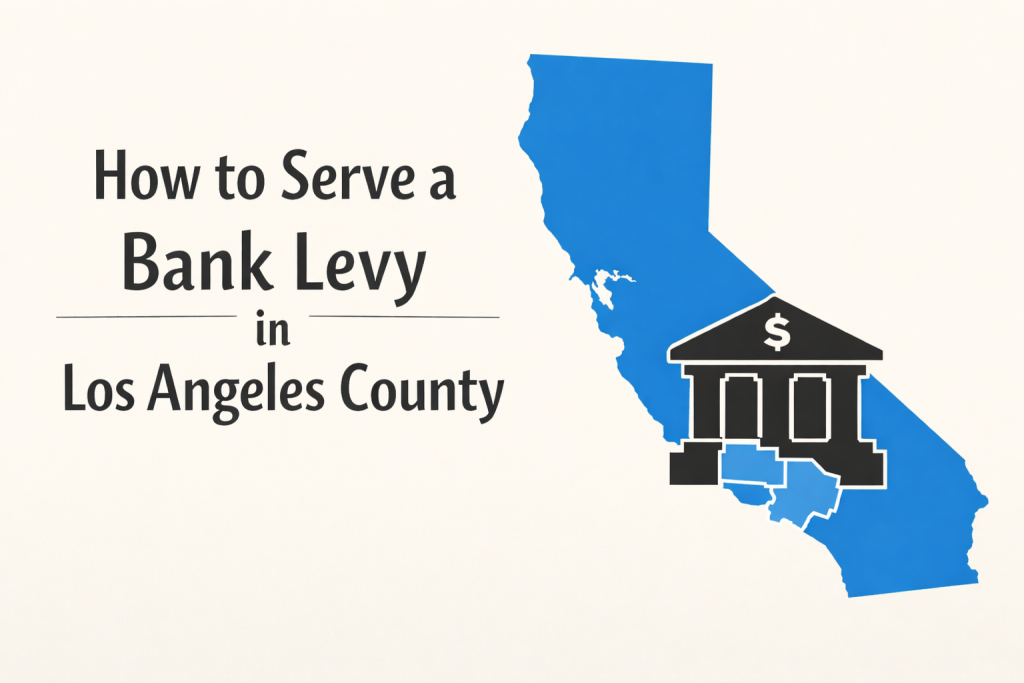
A bank levy is one of the most effective legal tools available to a judgment creditor seeking to collect money from a judgment debtor. When a court issues a judgment, the creditor can request a writ of execution, which authorizes a levying officer—typically the sheriff or a registered process server—to seize assets belonging to the debtor. Among the most accessible assets are funds held in the judgment debtor’s bank account.
To execute a bank levy, the judgment creditor must first identify the financial institution where the debtor banks. In California, many large banks are required by law to maintain a designated central address for receiving levy-related documents, streamlining the process and allowing creditors to execute bank levies immediately and efficiently. Once the correct bank and its central address are identified, the creditor prepares the necessary court forms and instructions, ensuring all details about the debtor’s bank accounts are accurate.
A registered process server or the sheriff’s department then serves the writ of execution and notice of levy on the financial institution. This action freezes the debtor’s funds, preventing withdrawals and allowing the levying officer to collect money directly from the account. For a successful bank levy, it is crucial to follow all procedural requirements, serve the correct branch or central location, and provide complete, accurate information. By understanding each step and acting quickly, creditors can maximize their chances of recovering the debt owed through a bank account levy.
Fill out: EJ–135 Declaration of Address Verification
Depending on the circumstances, you may also need to provide a certified copy of the court judgment, a fictitious business name statement, a spousal affidavit, or other documents such as a Claim of Exemptions or bank memoranda to support the levy file and ensure compliance with legal requirements.
Service should not occur until the file is accepted.
Once submitted, the LASD adopts the existing Case Number as a Levying Officer File Number. This number must appear on all subsequent documents.
The RPS named on SER-001/001A becomes authorised to carry out service. The Sheriff does not perform the physical service.
Under CCP § 684.115:
Note: If you are levying on accounts at multiple banks or in different counties, you must obtain a separate writ of execution for each bank or county.
Banks have 10 days to respond by returning the Memorandum of Garnishee and funds to the Sheriff. When a bank levy in Los Angeles County is served, the bank must complete a Memorandum of Garnishee confirming the amount of the debtor’s funds frozen in the debtor’s account. The bank is required to determine whether the funds in the debtor’s account are exempt from seizure; only non-exempt funds will be released to satisfy the judgment. A bank levy is an action by a judgment creditor to freeze the funds in the judgment debtor’s bank account and to authorize the bank to release any non-exempt funds to the creditor. The bank levy removes funds from the debtor’s bank accounts and delivers them to the creditor.
| Branch Name | Address | Phone |
|---|---|---|
| Central Branch | 110 N. Grand Ave., Rm 525, LA 90012 | (213) 974-6282 |
| Van Nuys Branch | 14400 Erwin St Mall, #110, Van Nuys 91401 | (818) 374-2511 |
| Pasadena Branch | 300 E. Walnut St., #208, Pasadena 91101 | (626) 356-5555 |
| Torrance Branch | 825 Maple Ave., #140, Torrance 90503 | (310) 222-3358 |
| Burbank Branch | 300 E. Olive St., #104, Burbank 91502 | (818) 557-3490 |
| Antelope Valley | 42011 4th St. W., #1570, Lancaster, 93534 | (661) 974-7800 |
| Long Beach | 275 Magnolia Ave., Rm 4000, 90802 | (562) 256-8291 |
| Santa Clarita | 23747 W. Valencia Blvd., #111, 91355 | (661) 253-7334 |
| Santa Monica | 1725 Main St., #114, 90401 | (310) 553-5033 |
| West Covina | 1427 W. Covina Pkwy., #127, 91790 | (626) 813-3255 |
Countrywide Process has decades of experience coordinating RPS-based bank levies in Los Angeles County. We understand:
Let us help your firm avoid costly rejection or release of levied funds. We act as your partner throughout the entire process.
To open a bank levy file in Los Angeles County, you must submit the original Writ of Execution (EJ-130), completed Sheriff instruction forms SER-001 and SER-001A, and a $50.00 deposit to the appropriate LASD Civil Management Bureau branch based on jurisdiction. The file must be opened before any service is performed.
Opening the file at the incorrect LASD Civil Division can result in the levy being rejected. You must file with the Sheriff branch that has jurisdiction over the address where the financial institution will be served. Use LASD’s online lookup tool to confirm the correct branch.
No. In Los Angeles County, the Sheriff acts only as the levying officer. A Registered Process Server (RPS) must carry out the actual service on the financial institution, as indicated in forms SER-001 and SER-001A
The RPS must serve the financial institution with a copy of the Writ of Execution (EJ-130), Notice of Levy (EJ-150), and Memorandum of Garnishee (EJ-152). Optional exemption claim forms EJ-155 through EJ-165 may also be included.
Under CCP § 684.115, if a bank has 10 or more branches in California, it may designate a Central Location for Service. Most major banks require service at these central offices—commonly in Downtown LA or Glendale. Serving the wrong location can void the levy.
The original Proof of Service must be filed with the same LASD Civil Branch where the levy was opened, within five (5) court days after the financial institution was served.
Once the bank sends funds to the Sheriff, there is a statutory waiting period—usually 15 to 20 days—to allow for any Claim of Exemption. If no claim is filed, the funds are disbursed to the judgment creditor.