A Practical Guide for Attorneys, Paralegals, and Real Estate Professionals
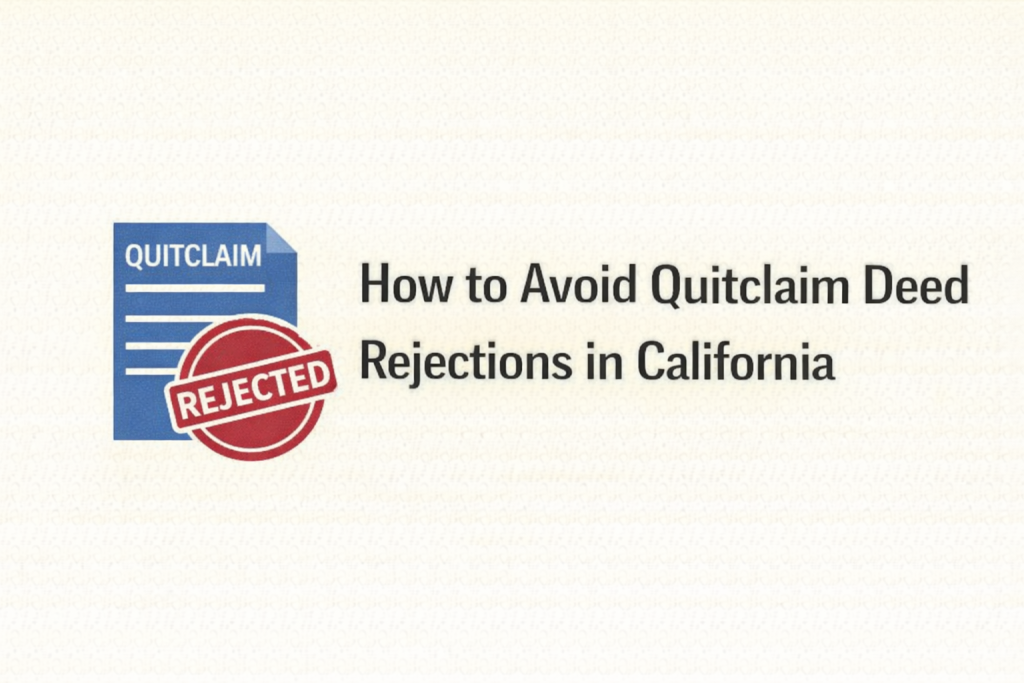
Quitclaim Deeds are commonly used in California for property transfers between spouses, family members, trusts, or as part of estate planning. However, Quitclaim Deeds are among the most frequently rejected documents by County Recorder offices due to technical and statutory errors.
For attorneys and legal professionals, understanding why Quitclaim Deeds are rejected—and how to prevent those rejections—is essential to protecting clients, avoiding delays, and reducing resubmission costs.
This article explains the most common rejection reasons, provides correct legal examples, and outlines best practices for preparing Recorder‑compliant Quitclaim Deeds in California.
Countrywide Process
January 24, 2026
A quitclaim deed is an essential legal document for transferring property ownership in California. Unlike other types of real estate documents, a quitclaim deed allows a person to transfer whatever interest they have in a property—without making any guarantees about the title’s validity. This makes quitclaim deeds a practical choice for situations where the parties know and trust each other, such as transfers between family members, spouses, or when updating property records to reflect changes in ownership.
When a quitclaim deed is properly prepared and notarized, and then recorded with the county recorder’s office, it helps establish a clear record of property ownership and can prevent potential disputes down the line. However, because a quitclaim deed only conveys the grantor’s current interest in the real property, it is crucial to understand that it does not protect against unknown claims or liens. For this reason, consulting with an attorney before executing a quitclaim deed is highly recommended to ensure the transfer is legally sound and all statutory requirements are met. Proper preparation and notarization are key to avoiding issues that could affect the property’s title or lead to future legal disputes.
Recording real estate documents, such as a quitclaim deed, is a crucial step in establishing and protecting property ownership in California. When a deed is submitted to the county recorder’s office, it becomes part of the official property records, providing public notice of the transfer and helping to safeguard against potential disputes over ownership. The recorder’s office is responsible for ensuring that all documents meet statutory requirements and are properly indexed for future reference.
In most counties, the recording process can now be completed electronically, which streamlines the submission of legal documents and reduces the risk of further delays. However, it remains essential to ensure that every document is properly prepared, with all signature lines, dates, and notary acknowledgments completed accurately. Missing information, incomplete notarization, or other typical errors can result in the document being rejected, causing unnecessary delays and additional costs.
To avoid these issues, it is important to carefully review all documents before submission and to be aware of the statutory requirements for recording real estate documents in California. Consulting with an attorney or using professional services can help ensure that the quitclaim deed and related documents are complete, properly notarized, and ready for acceptance by the county recorder’s office. Taking these steps not only protects your property interests but also helps maintain accurate and reliable property records for the future.
There are several common reasons why County Recorders reject quitclaim deeds. County Recorders apply strict review standards. Even when the transfer itself is legally valid, recording will be rejected if the document does not meet formatting and content requirements.
Providing accurate information in all sections of the deed is essential to avoid these common reasons for rejection.
The legal description must uniquely identify the exact parcel being transferred. A general reference to a tract or subdivision is not sufficient.
It is essential to provide accurate information in the legal description and ensure the real estate document is complete and properly formatted according to the county’s guidelines before submission.
THE FOLLOWING REAL PROPERTY IN THE CITY OF LOS ANGELES,
COUNTY OF LOS ANGELES, CALIFORNIA
TRACT NO. 1000, IN THE CITY OF LOS ANGELES,
COUNTY OF LOS ANGELES, STATE OF CALIFORNIA
TRACT NO. 1000, LOT 1, COMMONLY KNOWN AS 123 MAIN STREET, LOS ANGELES, CA 90001, IN THE CITY OF LOS ANGELES, COUNTY OF LOS ANGELES, STATE OF CALIFORNIA, AS PER MAP RECORDED IN BOOK XX, PAGE XX OF MAPS, IN THE OFFICE OF THE COUNTY RECORDER
Tip: Always pull the legal description from the most recent recorded deed or official county records rather than drafting it manually
To obtain the correct legal description, consult:
Conducting a thorough search of official county records is essential to ensure you obtain the correct legal description.
For an official overview of Quitclaim Deeds and their components, review: 🔗 Understanding Quitclaim Deeds – LA County
Even when no transfer tax is owed, California requires a clear explanation why the transaction is exempt from Documentary Transfer Tax. This exemption statement must comply with California law, specifically the legal requirements outlined in the California Revenue and Taxation Code.
It is important to note that the Documentary Transfer Tax (DTT) must be accurately calculated and paid according to law to avoid rejection of a deed in California.
Include a statement such as:
This transfer is exempt from Documentary Transfer Tax
under Revenue & Taxation Code Section 11927(a).
Without this language, County Recorders frequently reject the document—even when the exemption clearly applies.
It is important to identify the relevant exemption for your specific transaction to ensure compliance and avoid deed rejections in California.
According to the official DTT Memo – LA County, valid exemptions may include:
This exemption language should be placed near the tax declaration section of the deed.
Keep in mind, A separate Declaration of Documentary Transfer Tax form is primarily required for legal entity transfers where no deed is recorded, or if you want the tax amount kept private. Otherwise, the tax information is typically included directly on the deed itself.
County Recorder offices scan and index every recorded document. If content cannot be clearly read or indexed, rejection is likely.
Some counties also require a cover page to meet specific formatting requirements for recording. Failing to include a required cover page can result in deed rejections in California.
Additionally, it is important to ensure that notarial certificates in California include the required consumer notice in the correct location, as missing or misplaced notices are a common reason for rejection.
Recorder stamp area: Must remain blank
Electronic recording allows documents to be submitted directly to the county recorder’s office for faster acceptance and processing.
One of the most effective ways to avoid Quitclaim Deed rejections is to submit documents through a professional California eRecording service.
Countrywide Process provides eRecording services for:
Documents must be submitted, along with the required fees, to the county recorder’s office for recording to ensure proper legal standing.
We review submissions for common compliance issues before recording, helping you avoid:
Once your document is properly prepared, notarized, and submitted, most counties will accept and record corrective deeds within a few days to a few weeks.
📬 Submit Your Document for eRecording »
Quitclaim Deed rejections in California are rarely caused by complex legal issues. Instead, they typically result from:
By understanding Recorder requirements and using professional eRecording support, attorneys and legal professionals can ensure faster acceptance, fewer delays, and stronger client outcomes.
Quitclaim Deeds are commonly rejected due to incomplete legal descriptions, missing Documentary Transfer Tax exemption language, and formatting or legibility issues.
No. The legal description must include the specific lot number and reference the recorded map book and page.
A DTT exemption statement is required whenever no transfer tax is due, such as transfers between spouses or into a trust.
Use the most recent recorded deed or obtain records from the County Assessor or Registrar‑Recorder.
Yes. Most California counties accept Quitclaim Deeds via authorized eRecording service providers.